FAA Inspection Authorization (IAR) Knowledge Test, Practice Exams
Revision Mode
Revise with instant feedback: the moment you pick an answer you see whether it was right, with the handbook-cited explanation. Untimed — ideal before you sit a mock test. Questions you miss keep coming back until you know them.
Exam Mode
Test-day conditions: no feedback until you submit, each knowledge area scored separately, with a full question-by-question review at the end.
The real test requires 70% to pass. Each knowledge area is scored separately here so you know exactly where you stand.
Knowledge areas & your progress
Unlock the full question bank
The free sample is one full practice exam's worth of questions, with at least 5 in every knowledge area so you can revise each topic: 61 questions in all. The full bank covers every knowledge area in depth, with source-cited explanations. $49, one time, lifetime access on up to 3 devices — all five tests (Mechanic General, Airframe, Powerplant, Part 107 Remote Pilot, and Inspection Authorization) included.
✓ One purchase, every written test · up to 3 devices · no subscription · no account needed
Score history
The real exam: key facts
| Delivered by | PSI |
|---|---|
| Official exam | Inspection Authorization (IAR) |
| Questions | 50 |
| Time | 3 hours |
| Passing score | 70% |
| Pre-licensing or eligibility | Authorisation required: FAA Form 8610-1 with the Endorsement block completed (date, FAA inspector's original signature and office designation), issued by the FSDO. Applicant must meet 14 CFR 65.91 (A&P held at least 3 years, actively maintaining aircraft for the 2 years before applying, fixed base, equipment and data). Minimum age 21 (matrix). FTN from IACRA needed to schedule. |
| Book your exam | faa.psiexams.com/faa/login |
Checked 11 October 2026 from the official sources below. Rules and fees change, so confirm with PSI before you book.
How Hangar Prep compares
Hangar is a $49 question bank covering five FAA knowledge tests, not a ground school. Here is how it compares with the test prep candidates usually consider, including where they are the better choice. See the comparison with Gleim Aviation, ASA Prepware, King Schools and others.
Reviews
Review
Frequently asked questions
How is the FAA Inspection Authorization (IAR) Knowledge Test structured?
The real Inspection Authorization written test has 50 multiple-choice questions (3 options each), a 3-hour time limit, and requires 70% to pass. Questions are drawn across 11 knowledge areas. The FAA publishes no ACS and no percentage weighting for this test, so these were derived by classifying its own 50 published sample questions, and this bank mirrors them.
What score do I need to pass?
70 percent. Revise each knowledge area to that level in Revision Mode, then run the full exam simulation in Exam Mode before your test date.
Are these real FAA exam questions?
The live test bank is not published. Our questions include the FAA's own published sample questions plus original questions written to knowledge areas derived from the FAA's own published sample questions and grounded in 14 CFR parts 1, 21, 23, 39, 43, 65 and 91, AC 43.13-1B, AC 120-77 and the FAA Aviation Maintenance Technician Handbooks, with the source cited in each explanation.
How many practice questions are included?
The full Inspection Authorization bank contains 250 questions with explanations. The free sample is one full practice exam's worth of questions, with at least 5 in every knowledge area so you can revise each topic: 61 questions in all.
Who is eligible to sit the IA knowledge test?
14 CFR 65.91 sets the bar before the test: a currently effective mechanic certificate with both airframe and powerplant ratings, each held for at least 3 years; at least 2 years actively maintaining certificated aircraft immediately beforehand; a fixed base of operations; and the equipment, facilities and inspection data to do the inspecting. Fail the written and you may not apply to retest for 90 days.
What does access cost?
$49, one time, for lifetime access to every test on the site and everything we add later. No subscription.
Can I use it on more than one device?
Yes. One purchase works on up to 3 of your devices. Your progress is saved on each device.
Do I need to create an account?
No. The practice tests run in your browser with no signup. Your score history is saved on your own device.
What topics does the FAA Inspection Authorization (IAR) Knowledge Test question bank cover?
It is organised into 11 modules that follow the exam's own content areas: Major repairs and major alterations, Inspection programmes: annual, progressive and 100-hour, Return to service and IA privileges, Maintenance records and FAA Form 337, Approved data, STCs and Type Certificate Data Sheets, Airworthiness Directives and service information, Instructions for Continued Airworthiness, Weight and balance after repair or alteration, Sheet metal and structural repairs, Aircraft systems: hydraulic, electrical and instrument and Engines and propellers. Each module is drilled and scored separately, so you can see exactly which areas are exam-ready and which still need work.
When was this question bank last updated?
Last updated 16 September 2026. The bank is revised whenever the source material it cites changes, and every question carries the source its explanation is drawn from.
Sample FAA Inspection Authorization (IAR) Knowledge Test practice questions
A selection of free questions with answers and explanations. Use the interactive modules above for timed, scored drills.
43.2 restricts how an item may be described in a maintenance record. A component may be described as REBUILT only where it has been
- disassembled, cleaned, inspected, repaired as necessary and reassembled using methods acceptable to the Administrator, then tested to approved standards
- disassembled, cleaned, inspected, repaired as necessary, reassembled and tested to the same tolerances and limits as a new item, using new parts or used parts within new-part limits ✓
- returned to the manufacturer or to an agency approved by the manufacturer, which then issues a new maintenance record without previous operating history
Why: 43.2(b) sets the rebuilt standard at new-item tolerances and limits, with parts that are either new or used but conforming to new-part tolerances and limits or to approved oversize or undersize dimensions. The first option is 43.2(a), the OVERHAULED standard, which is a lower bar - it tests to approved standards and technical data rather than to new limits. The third describes what 91.421 allows AFTER an engine is rebuilt, which is a records consequence and not the definition.
A turbine-powered aircraft is being approved for return to service after a progressive inspection. Is an engine run required first?
- Yes - 43.15(c)(3) requires it after an annual, 100-hour or progressive inspection ✓
- No - the engine run applies only to annual and 100-hour inspections
- No - engine runs are required only for reciprocating engines
Why: 43.15(c)(3) is written separately from the reciprocating-engine rule and casts a wider net: each person approving a turbine-engine-powered aircraft for return to service after an annual, 100-hour OR progressive inspection must first run the engines to determine satisfactory performance in accordance with the manufacturer's recommendations. The reciprocating rule in (c)(2) names only annual and 100-hour, which is the asymmetry the question turns on.
Which of the following does part 23 appendix A require to be in the airplane maintenance manual or section?
- A list of the special tools needed for maintenance of the airplane and its installed products and appliances
- Details for the application of special inspection techniques such as radiographic and ultrasonic testing where the applicant specifies those processes
- Servicing information covering servicing points, tank and reservoir capacities, fluid types, system pressures, access panel locations, lubrication points and jacking and levelling information ✓
Why: The servicing information is item (a)(4) of the contents paragraph, inside the airplane maintenance manual or section, alongside the introduction information, the description of the airplane and its systems, and the basic control and operation information. The special tools list and the special inspection techniques are both required by the appendix, but as separate items at (g) and (d) rather than as part of the maintenance manual section - which is the distinction this item turns on.
Show more sample questions with answers & explanations
Which combination of certificates and experience does 65.91(c)(1) require of an applicant for an inspection authorization?
- A mechanic certificate with either an airframe or a powerplant rating, currently effective and held for at least 3 years in total
- A mechanic certificate with an airframe rating and a powerplant rating, currently effective, with no minimum period specified in the regulation
- A mechanic certificate with an airframe rating and a powerplant rating, each currently effective and each held for at least 3 years ✓
Why: 65.91(c)(1) asks for both ratings, each currently effective, and each in effect for a total of at least 3 years. All three parts have to be satisfied together - one rating is not enough, and the three-year clock is explicit in the rule. It is a separate requirement from 65.91(c)(2), which asks for two years actively engaged in maintaining aircraft immediately before the application.
A hydraulic system operates satisfactorily on a ground test unit but will not build pressure on its own pump. What does the circular suggest?
- Replace the pressure regulator, since the fault must lie in a component the ground unit bypasses
- Bleed the system, since the symptom is characteristic of air trapped on the suction side of the pump
- Examine the pump ✓
Why: The test has already isolated the fault: everything downstream of the pump has been shown to work. The same paragraph lists what else can cause a lack of pressure - a sheared pump shaft, a defective relief valve, the pressure regulator, an unloading valve stuck in the kicked-out position, lack of fluid, a check valve installed backwards, or anything that lets fluid flow freely back to the reservoir or overboard.
What is a circuit breaker in an aircraft electrical system designed to protect?
- The wire ✓
- The equipment connected to the circuit, by opening before the unit can be damaged by an overload
- The generator or alternator, by shedding the load before the charging system is overloaded
Why: The circuit breaker protects the wire, not the black box on the end of it. That is why wires must be sized to carry continuous current in excess of the protective device's rating, allowing for its time-current characteristics, and why a breaker must always open before any component downstream can overheat and generate smoke or fire. It follows that a breaker cannot be relied on to save a component, and the circular separately advises that using a circuit breaker as a switch is not recommended because it shortens the breaker's life.
An extended-range fuel tank is installed inside a baggage compartment. How does part 43 appendix B change the handling of the Form 337?
- The form is executed in at least triplicate, and one completed copy is placed on board the aircraft as specified in 91.417 ✓
- The form is executed in duplicate as usual, but the copy sent to Oklahoma City must be marked to identify the installation
- No Form 337 is required, because the installation is covered by the supplemental type certificate for the tank
Why: Appendix B(d) is written for exactly this case: for extended-range fuel tanks installed within the passenger compartment or a baggage compartment, the form is executed in at least triplicate, with one completed copy placed on board the aircraft as specified in 91.417, one given to the owner and one forwarded to the Aircraft Registration Branch within 48 hours. 91.417(d) states the on-board requirement from the owner's side, so the two rules meet.
Before approving a reciprocating-engine aircraft for return to service after a 100-hour inspection, which of these must the engine run establish?
- Cylinder head temperature stabilised within the green arc, and oil consumption measured over a ten minute run at cruise power
- Static and idle rpm, magneto operation, fuel and oil pressure, and cylinder and oil temperature ✓
- Idle mixture, accelerator pump operation, and magneto drop at the run-up speed
Why: 43.15(c)(2) names four things and calls the first of them power output, expressed as static and idle rpm. All of them are determined in accordance with the manufacturer's recommendations. A turbine-powered aircraft has its own rule at 43.15(c)(3) - the engines are run to determine satisfactory performance to the manufacturer's recommendations, and that rule covers progressive inspections as well as annual and 100-hour ones.
An inspection authorization holder reaches 31 March of the first year of the two-year period without completing any of the five renewal activities. What happens?
- Nothing until the authorization expires, since the activities only have to be complete by the end of the two-year period
- The authorization is revoked and the holder must reapply and sit the written test again
- The holder may not exercise inspection authorization privileges after that date, and may resume only after passing an oral test from an FAA inspector ✓
Why: 65.93(c) makes the first-year milestone real: miss it and the privileges stop on 31 March, but the authorization itself is not revoked. Passing an oral test from an FAA inspector, showing that knowledge of the applicable regulations and standards is current, both restores the privileges and is deemed to satisfy the first year's activity requirement. A second activity is still needed during the second year.
Which section of the Instructions for Continued Airworthiness is FAA approved?
- The maintenance instructions section, which sets the recommended cleaning, inspection, adjustment, test and lubrication periods for each part of the airplane
- The Airworthiness Limitations section ✓
- The airplane maintenance manual section, which describes the airplane, its systems and installations and the servicing information for them
Why: Part 23 appendix A requires the Airworthiness Limitations to be a section that is segregated and clearly distinguishable from the rest of the document, and to carry a legible statement in a prominent place saying the section is FAA approved and specifies maintenance required under 43.16 and 91.403. The rest of the ICA is acceptable data under 43.13(a), not approved data - AC 120-77 paragraph 6a says the FAA does not approve all service documents but does approve this section.
An owner wants to address an unsafe condition by a method other than the one set out in the airworthiness directive. What does part 39 allow?
- Nothing - an AD is a legally enforceable rule and its stated method of compliance is mandatory in every case
- The owner may use any method that an appropriately rated mechanic certifies provides an equivalent level of safety, and record it in the aircraft records
- Anyone may propose an alternative method of compliance, or a change in the compliance time, and may use it only once the manager of the named office approves it ✓
Why: 39.19 opens the proposal to anyone, covers both an alternative method and a change in the compliance time, and sets the condition that the proposal provides an acceptable level of safety. The route runs through the principal inspector, who may add comments and forwards it to the manager of the office identified in the AD; where there is no principal inspector it goes straight to the manager. The closing sentence is the one that matters in the hangar - the alternative may be used only if the manager approves it.
43.5 lists what must be done before any aircraft may be approved for return to service after an alteration. Which of the following is one of those requirements?
- The aircraft must be weighed and a new empty weight and empty weight centre of gravity entered in the records, whether or not the alteration affected the weight or the balance
- The responsible Flight Standards office must be notified in writing that the alteration has been completed, within 48 hours of the aircraft being approved for return to service
- Where the alteration changes the operating limitations or flight data in the approved flight manual, those must be appropriately revised and set out as prescribed in 91.9 ✓
Why: 43.5 has three conditions: the maintenance record entry required by 43.9 or 43.11 has been made; the repair or alteration form authorised or furnished by the Administrator has been executed as prescribed; and, where a repair or alteration changes the operating limitations or flight data in the approved flight manual, those are revised and set out as 91.9 prescribes. Reweighing is often necessary in practice but it is not one of the three conditions, and no notification to Flight Standards is called for.
An item weighing 5 lb is installed at an arm of -28 inches. What is its moment, and which way does it tend to rotate the aircraft?
- -140 in-lb, tending to rotate the aircraft nose down
- +140 in-lb, tending to rotate the aircraft nose up
- -140 in-lb, tending to rotate the aircraft nose up ✓
Why: Moment is weight times arm, so 5 lb at -28 inches gives -140 in-lb. The sign convention is worth holding as a table: a positive weight at a positive arm gives a positive moment and a nose-up tendency; a positive weight at a NEGATIVE arm gives a negative moment and a nose-DOWN tendency; a negative weight - an item removed - at a positive arm gives a negative moment and nose down; and a negative weight at a negative arm gives a positive moment and nose up. Here the weight is added forward of the datum, so the aircraft goes nose down.
What must the current status of applicable airworthiness directives in the 91.417(a)(2) records show?
- The AD number, the revision date, and confirmation that the responsible Flight Standards office has been notified of compliance
- The AD number and the method of compliance only, since the dates are recoverable from the maintenance entries
- The method of compliance, the AD number and revision date, and for a recurring AD the time and date when the next action is required ✓
Why: 91.417(a)(2)(v) asks for all four elements, and the recurring-AD clause is the one that gets dropped. Without the next-due time and date, a buyer or an inspector cannot tell whether a recurring AD is current, which is the whole point of keeping the status in the permanent record set. Nothing in the paragraph requires the FAA to be notified of compliance.
A propeller-equipped aircraft vibrates only between 2,200 and 2,350 rpm. What does the handbook say this indicates?
- Not normally a propeller problem, but a poor engine-propeller match ✓
- A propeller balance problem, since an out-of-balance condition shows up most strongly at the resonant speed of the blades
- A cracked or deformed spinner, which produces a vibration confined to a narrow band of engine speed
Why: The distinction the handbook draws is by rpm range. A propeller that vibrates because of balance, angle or track typically vibrates throughout the whole rpm range, though the intensity may vary; vibration confined to one speed or a narrow band points to a poor engine-propeller match instead. A spinner problem is diagnosed differently again - by a noticeable spinner wobble with the engine running, usually from inadequate shimming of the front support or a cracked or deformed spinner.
AC 120-77 defines approved data. What is it?
- Any data issued by the holder of the type certificate for the product, including maintenance manuals and structural repair manuals
- Data that an appropriately rated certificated repair station has found to return the article to its original or properly altered condition
- Technical and/or substantiating data that has been approved by the FAA ✓
Why: Paragraph 5c of AC 120-77 is that short, and the brevity is the point: what makes data approved is an FAA approval, not its author and not its quality. Paragraph 5m puts manufacturers' service documents in a different box - maintenance manuals, overhaul manuals, ICA, component maintenance manuals, structural repair manuals, service bulletins and letters are publications providing ACCEPTABLE methods, techniques and practices. Paragraph 5n says a certificate holder's instructions are acceptable where they will return the article to its original or properly altered condition.
Approval of a major repair for return to service may NOT be made by the holder of an inspection authorization unless
- the product was repaired by a certificated repairman holding an appropriate rating.
- he or she has performed or supervised the performance of a similar repair.
- technical data approved by the Administrator was used to accomplish the work. ✓
Why: 65.95(a)(1) lets an IA holder inspect and approve for return to service after a major repair or major alteration only if the work was done in accordance with technical data approved by the Administrator. The rule says nothing about who physically did the work, nor about the IA having done a similar job before - the condition is the data.
A de-icing system is being redesigned on a light twin, changing the basic design of the system. How does appendix A classify that work?
- An airframe major alteration ✓
- A minor alteration unless the aircraft's weight changes
- An appliance major repair
Why: Appendix A(a)(1)(xii) names changes to the basic design of the fuel, oil, cooling, heating, cabin pressurisation, electrical, hydraulic, de-icing or exhaust systems as airframe major alterations. Weight is a separate trigger under sub-paragraph (xi), not a condition on this one, so an unchanged weight does not demote the work. An appliance major repair is a different list entirely, at appendix A(b)(4).
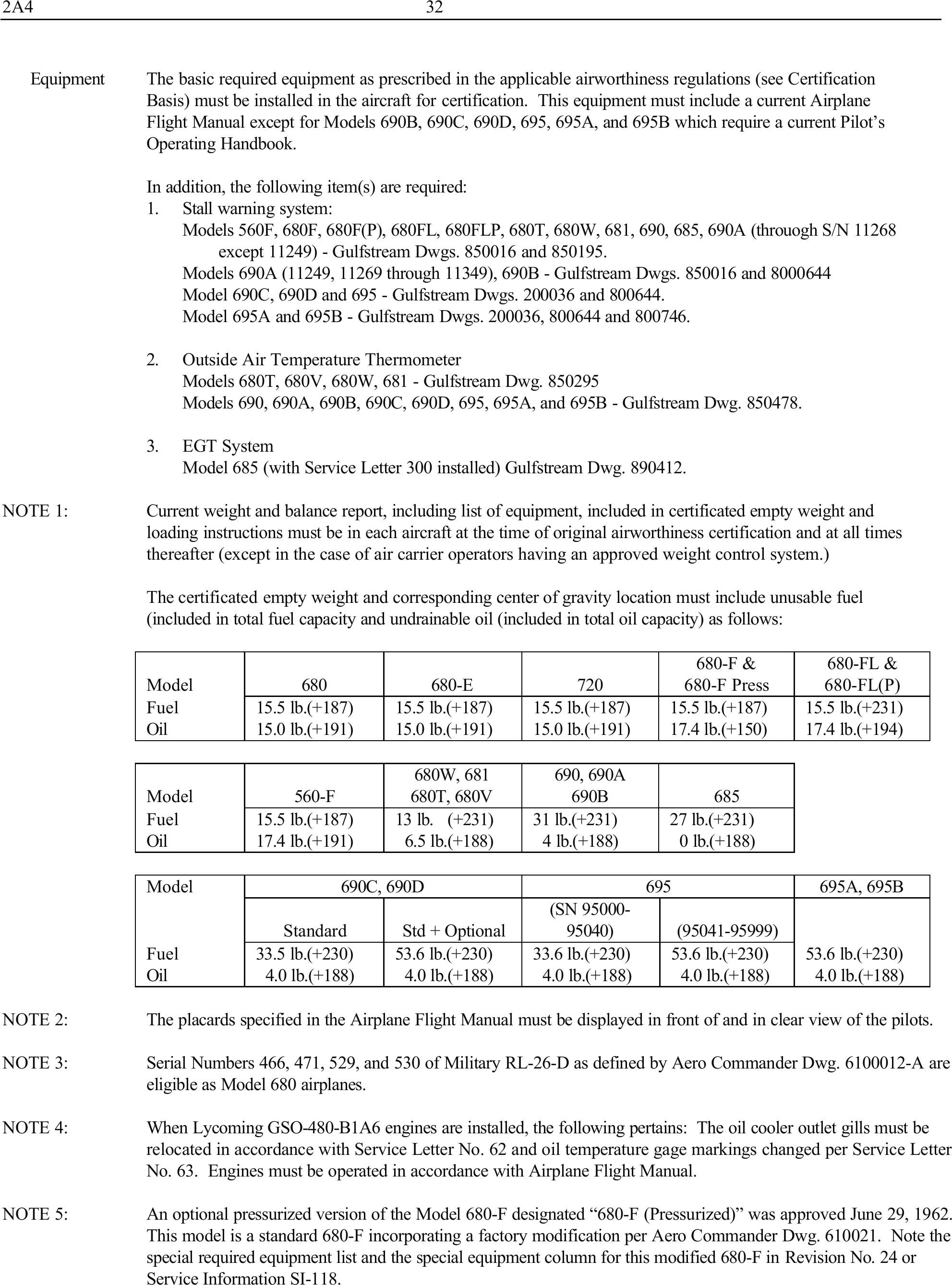
(Refer to the Type Certificate Data Sheet excerpt.) What is the total weight of unusable fuel on a Twin Aero Commander, model 695, serial number 95039?
- 31.0 lb.
- 33.6 lb. ✓
- 33.5 lb.
Why: In NOTE 1's third table the 695 column is split by serial number: 33.6 lb. at (+230) for SN 95000 through 95040, and 53.6 lb. at (+230) for 95041 through 95999. Serial 95039 falls in the first block. Take care with the neighbouring columns - 33.5 lb. is the figure for the 690C and 690D Standard, and 31.0 lb. belongs to the Model 685.
What tolerance does the Powerplant handbook give for propeller blade tracking?
- Within 1/32 inch of the mean of all the blade tracks on the propeller
- Within 1/16 inch, plus or minus, of the opposite blade's track ✓
- Within 1/8 inch, plus or minus, of the track of the blade nearest the ground
Why: A sixteenth of an inch either way from the opposite blade's track is the figure in the handbook's own procedure, subject always to the tolerance specified by the propeller manufacturer. Tracking shows only the relative position of the blade tips, not their actual path. An out-of-track propeller may be due to one or more bent blades, a bent propeller flange, or mounting bolts that are over- or under-torqued.
An engine is converted so that it can run on a grade of fuel other than the one listed in the engine specifications. This conversion is
- a minor alteration, since the engine's compression ratio is unchanged
- a powerplant major alteration ✓
- a powerplant major repair
Why: Appendix A(a)(2)(vi) names conversions of any sort for the purpose of using fuel of a rating or grade other than that listed in the engine specifications. The phrase 'of any sort' is what disposes of the compression-ratio argument - the list does not ask how the conversion was achieved. It is an alteration rather than a repair because nothing was returned to a former condition.
An adverse-loaded CG check is required on a turbine-powered aircraft. How is the minimum fuel determined?
- By the same rule as for a piston aircraft, using the equivalent shaft horsepower in place of METO horsepower
- By taking the fuel needed for thirty minutes at maximum continuous thrust from the approved flight manual performance section
- The aircraft manufacturer must supply the minimum fuel figure ✓
Why: The METO horsepower rule is written for piston engines and the handbook says so explicitly: for turbine engine powered aircraft minimum fuel is not based on engine horsepower, and the manufacturer would need to supply the information. Substituting shaft horsepower into a rule of thumb derived from piston fuel consumption has no basis, and the flight manual is not where the handbook sends you.
Under 43.13(a), what methods, techniques and practices must a person use when performing maintenance on an aircraft?
- Those prescribed in the current manufacturer's maintenance manual or Instructions for Continued Airworthiness, or other methods acceptable to the Administrator ✓
- Only those contained in data specifically approved by the Administrator for that make and model of aircraft
- Those contained in AC 43.13-1B, which the Administrator has approved as the standard for all aircraft maintenance
Why: 43.13(a) sets an ACCEPTABLE standard, not an approved one, and names the manufacturer's current maintenance manual or ICA as the primary source with other acceptable methods as an alternative. The section also requires the tools, equipment and test apparatus needed to complete the work to accepted industry practices, and requires the manufacturer's recommended special equipment or an acceptable equivalent. AC 43.13-1B is acceptable data for the practices it covers, but it is not approved data and it does not displace the manufacturer's manual.
An owner asks you to alter an aircraft using a supplemental type certificate held by a third party. What does 91.403(d) require?
- That the alteration is recorded on FAA Form 337 and the STC number entered in block 8, which is all the regulation asks of the installer
- That the owner or operator holds the STC, or has written permission from the holder to use it ✓
- That the STC holder supervises the installation, or delegates supervision in writing to a certificated repair station
Why: 91.403(d) is short and absolute: an aircraft must not be altered on the basis of an STC unless the owner or operator is the holder of it or has written permission from the holder. The obligation on the other side is in 21.120 - an STC holder who allows a person to use the STC to alter an aircraft, engine or propeller must provide that person with written permission acceptable to the FAA. Recording the work properly is a separate duty and does not create the right to do it.
What is the K-factor, and what value does it take for a 90 degree bend?
- The ratio of the bend radius to the metal thickness; it is 1 for a 90 degree bend in material of any thickness
- The percentage of the material thickness that lies on the compression side of the neutral axis; it is 0.5 for a 90 degree bend
- The tangent of one half of the bend angle; it is 1 for a 90 degree bend ✓
Why: K is the tangent of half the bend angle - tan 45 degrees for a 90 degree bend, which is exactly 1 - and that is why setback for a 90 degree bend reduces to the familiar R plus T with no multiplier in sight. The K chart carries one of 179 numbers, one for each whole angle between 0 and 180 degrees, and the handbook says outright that the K-factor must be used for all bends smaller or larger than 90 degrees.
Under AC 120-77, who classifies a structural repair as major or minor?
- The operator, which may then use an FAA-approved SRM to accomplish repairs it has classified either way ✓
- The manufacturer, through the classification printed against each repair scheme in the structural repair manual
- The responsible Flight Standards office, on submission of the proposed repair scheme by the operator
Why: AC 120-77 paragraph 8b(1) puts the classification on the operator and adds that an FAA-approved SRM may be used for repairs classified as major or as minor. The sentence that follows is the working limit on that freedom: an operator must support CHANGES to repairs. Paragraph 12a then sets out the three things a change has to satisfy - the operator's own manual procedures, a showing of compliance with the relevant airworthiness standards, and approved technical data where the change is classified as major.
Which appendix of 14 CFR part 43 specifies the performance of certain alterations as a major?
- Appendix A. ✓
- Appendix B.
- Appendix D.
Why: Appendix A to Part 43 is the one that classifies work: it lists major alterations, major repairs and preventive maintenance. Appendix B covers the recording of major repairs and major alterations, and Appendix D gives the scope and detail of an annual or 100-hour inspection.
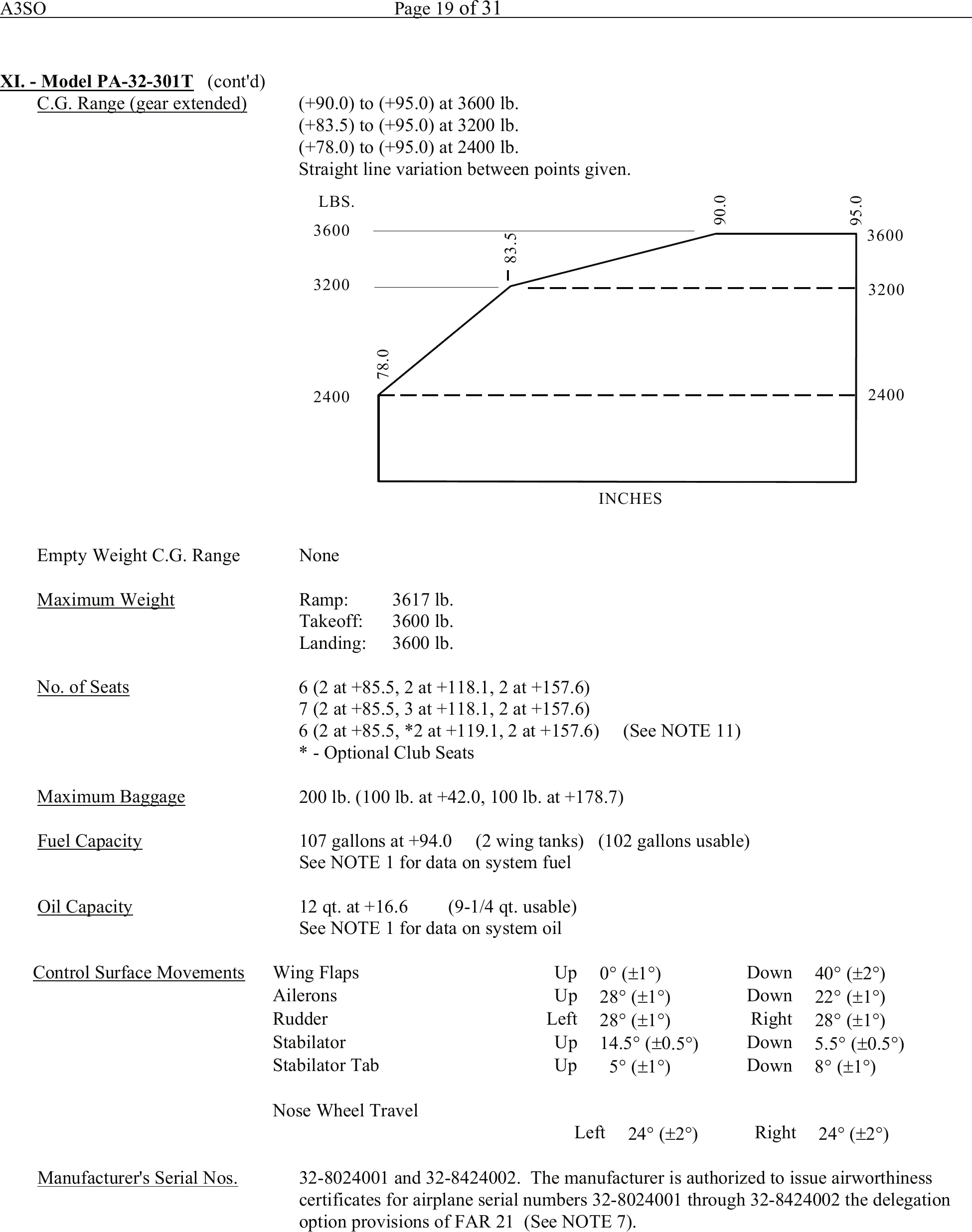
(Refer to the Type Certificate Data Sheet excerpt.) How many club seats may be installed in Piper PA32-301T, serial number 8221552?
- 1
- 2 ✓
- 4
Why: Serial 32-8221552 falls inside the range the data sheet gives for the PA-32-301T, 32-8024001 through 32-8424002. The seating entry for that model offers three arrangements, and the one marked with an asterisk reads 6 (2 at +85.5, *2 at +119.1, 2 at +157.6), with the footnote '* - Optional Club Seats'. Two seats carry the asterisk, so two club seats may be installed.
Who must be given the Instructions for Continued Airworthiness, and when?
- The FAA, before the first standard airworthiness certificate is issued for an aircraft of that type
- The owner of each aircraft, engine or propeller, on delivery or on issue of the first standard airworthiness certificate, whichever is later ✓
- Any certificated repair station that requests them, on payment of the design approval holder's reasonable copying charge
Why: 21.50(b) sets the delivery obligation on the holder of a design approval - a type certificate or a supplemental type certificate - for products for which application was made after 28 January 1981. At least one complete set goes to the owner, and thereafter the instructions, and any changes to them, must be made available to any other person required by the chapter to comply with them. That second obligation is what a repair station relies on, and it is not conditioned on a charge.
An inspection authorization holder gives up the fixed base of operation from which the authorization was issued. What is the effect?
- The authorization ceases to be effective, because 65.92(b) names loss of the fixed base of operation as one of the events that ends it ✓
- The authorization remains effective until its normal expiry date, provided the holder tells the responsible Flight Standards office in writing
- The authorization is suspended for 90 days, after which it may be restored by an oral test from an FAA inspector
Why: 65.92(b) lists three events that end an authorization's effect: surrender, suspension or revocation; the holder no longer having a fixed base of operation; and the holder no longer having the equipment, facilities and inspection data that 65.91(c)(3) and (4) required for issue. None of them is a suspension with a fixed term, and none is cured by a notification. Notifying the FAA in writing belongs to a different situation - 65.95(c), where the holder MOVES the fixed base rather than losing it.
A Cessna 421B operated as a 14 CFR part 91 airplane would have inspections conducted in accordance with
- 14 CFR part 43, appendix D.
- 14 CFR part 91, section 91.409 (Inspections). ✓
- 14 CFR part 43, section 43.16 (Airworthiness Limitations).
Why: 91.409 is the rule that requires the inspection and sets the interval. Appendix D to Part 43 is not a requirement in its own right - it prescribes the scope and detail once 91.409 has told you an inspection is due - and 43.16 deals with airworthiness limitations, which is a separate obligation.
An inspection or other procedure developed to prevent structural failures from foreseeable causes of strength degradation must be included where?
- In the airplane maintenance manual section of the Instructions for Continued Airworthiness for the airplane
- In the Airworthiness Limitations section of the Instructions for Continued Airworthiness ✓
- In the type certificate data sheet, as a note against the affected serial range
Why: Part 23 requires the applicant to develop and implement inspections or other procedures to prevent structural failures due to foreseeable causes of strength degradation that could cause serious or fatal injuries or extended operation with reduced safety margins, and to put each of them in the Airworthiness Limitations section required by 23.1529. That is consistent with what the section is for, since the limitations section is part of the type design under 21.31(c) and is the only FAA approved part of the ICA.
A light twin-engine airplane has its empty weight center of gravity at 24.5 percent of the mean aerodynamic cord (MAC). Using the following information, determine the location of the center of gravity in inches. MAC 75.5 inches. Leading edge of MAC at flight station 144.8. Empty weight 7201 lbs.
- 158.76
- 163.29 ✓
- 175.15
Why: A percentage of MAC is measured aft from the leading edge of the MAC, so the station is the leading edge plus that fraction of the chord: 144.8 plus 0.245 times 75.5, which is 144.8 plus 18.4975, or 163.2975 inches. The empty weight of 7201 lb is not needed for this calculation at all - it is there to be picked up and used by mistake.
A rivet has to be removed because its hole has become elongated. What does AC 43.13-1B allow?
- The hole may be drilled or reamed for the next larger size rivet, provided the edge distance and spacing stay at or above the minimums ✓
- The hole may be filled with a plug and a new hole drilled beside it at the correct spacing from the adjacent rivets
- The rivet may be replaced with a blind rivet of the same diameter, which expands to fill the elongated hole
Why: Going up one size is the approved remedy, and the proviso is the part that decides whether it can be used here: a bigger rivet needs more edge distance and more spacing, so a hole close to an edge may no longer qualify. That is the practical reason the Airframe handbook recommends laying out repairs with a sixteenth of an inch in hand. Blind rivets are not a general substitute and their use in airframe metal repairs needs specific authorisation.
14 CFR 43.15(c) requires a checklist for an annual or 100-hour inspection. Which statement about that checklist is correct?
- It must be the checklist published by the manufacturer of the aircraft
- It may be of the inspector's own design, provided it includes the scope and detail of part 43 appendix D ✓
- It is required only where the manufacturer has not published an inspection programme
Why: 43.15(c)(1) says the checklist may be of the person's own design, one provided by the manufacturer of the equipment being inspected, or one obtained from another source - but that it must include the scope and detail of the items in appendix D and, for rotorcraft, the items in 43.15(b). So the source of the checklist is free and its content is not. The requirement to use one is unconditional.
Which statement about design changes to an article produced under a PMA is correct?
- A minor change is one with no appreciable effect on the approval basis and may be approved by a method acceptable to the FAA; a major change needs FAA approval first ✓
- Every design change requires prior FAA approval, because a PMA covers both the design and the production of the article and the approval basis depends on both of them
- Design changes are classified by the holder of the type certificate for the product on which the article is installed
Why: 21.319(a) defines a minor change to a PMA article as one with no appreciable effect on the APPROVAL BASIS - a different yardstick from 21.93, which measures a type design change against weight, balance, structural strength, reliability and operational characteristics. 21.319(b) then splits the approval route the same way part 21 splits it everywhere else. 21.320 adds a separate duty: any change to the quality system is subject to FAA review, and the holder must notify the FAA immediately in writing of a change that may affect inspection, conformity or airworthiness.
Under 43.9(a), what must a maintenance record entry contain when a mechanic completes work other than a required inspection?
- A description of the work performed, the total time in service of the airframe at completion, and the signature and certificate number of the person approving the work
- A description of the work performed, the date of completion, and a statement that the aircraft has been determined to be in airworthy condition
- A description of the work performed, the date of completion, and the signature, certificate number and kind of certificate held by the person approving the work ✓
Why: 43.9(a) lists four things: a description of the work, or a reference to data acceptable to the Administrator; the date of completion; the name of the person who did the work if that is not the person signing; and the signature, certificate number and kind of certificate held by the person approving the work. Total time in service belongs to inspection entries under 43.11(a)(2), and the airworthy-condition certification belongs to 43.11(a)(4) - both are inspection records, which 43.9 expressly does not cover.
A TSO authorization holder wants to use a design that deviates from a performance standard in the TSO. What is required?
- Nothing at all, provided the article meets or exceeds the overall level of performance that the TSO was written to secure and the holder records the deviation in the technical data it keeps for the article
- FAA approval of the deviation, applied for with data showing that the standards from which a deviation is sought are compensated for by factors or design features providing an equivalent level of safety ✓
- A new TSO authorization for the deviating article, applied for in the same form and manner as the original one, which is then surrendered to the FAA once the replacement authorization has been issued
Why: 21.618 puts the burden on the manufacturer requesting the deviation: it must show that factors or design features providing an equivalent level of safety compensate for the standards deviated from, and must send the request with all pertinent data to the FAA. It is worth holding alongside 21.619, under which a manufacturer holding a TSO authorization may make MINOR design changes without further FAA approval, and 21.613, under which a TSO authorization is effective until surrendered, withdrawn or otherwise terminated by the FAA.
What does a cylinder compression test determine, and what is it for?
- Whether the cylinder is developing its rated power, so as to establish the engine's remaining service life before overhaul
- Whether the valve clearances are correctly set, so as to decide whether the rocker covers need to come off at this inspection
- Whether the valves, piston rings and pistons are sealing the combustion chamber, so as to decide whether cylinder replacement is necessary ✓
Why: The test is about sealing, and the decision it supports is a cylinder change - the handbook's point being that finding and replacing a defective cylinder prevents a complete engine change through cylinder failure. Low compression can most often be traced to leaky valves. Incorrect valve clearances are one of the CONDITIONS that affect compression, alongside a worn or damaged piston, excessive wear of rings and cylinder walls, burned or warped valves, and carbon between a valve face and its seat.
A hydraulic unit has been disassembled to replace a leaking seal. What does AC 43.13-1B require of the seals?
- The undamaged seals may be refitted, only those showing cuts or abrasion being replaced, provided they are cleaned in the system fluid first
- All O-ring and Chevron seals must be removed and replaced with new seals of the same material and the correct part number, with unexpired shelf life ✓
- All seals must be replaced with the latest part number superseding the original, since seal materials are improved over the life of a design
Why: Once the unit is open, every O-ring and Chevron seal comes out and new ones go in - and the circular is specific that no seal should be installed unless it is positively identified as the correct part and its shelf life has not expired. The separate list of do's and don'ts says never to reuse O-ring seals at all, because they swell from exposure to fluids and take a set under pressure, and may carry minor cuts or abrasions that cannot be seen.
What does AC 43.13-1B say about leakage from a stationary connection in a hydraulic system?
- It is acceptable up to a slow drip, which is the standard the circular applies to any connection carrying phosphate ester fluid
- It is not permitted, and if found it should be repaired ✓
- It is acceptable provided the system fluid level does not fall measurably between scheduled inspections
Why: No leakage at all from a stationary connection. The judgement calls in the circular are about SEALS rather than connections, and they are framed as four questions: how much fluid is allowed to seep past, what effect the leak has on system operation, whether it creates a hazard or affects surrounding installations, and whether the system will function safely without depleting the reservoirs before the next inspection.
Which of these does part 43 appendix D require to be inspected in the engine and nacelle group?
- The crankshaft for runout at the propeller flange, and the camshaft lobes through the oil filler opening for wear and pitting
- The engine mount for cracks, looseness of mounting and looseness of engine to mount, and flexible vibration dampeners for poor condition and deterioration ✓
- The magnetos for internal timing and the carburettor for float level, both of which the appendix requires at every annual inspection
Why: Both items are in appendix D(d), which runs from the engine section for visual evidence of oil, fuel or hydraulic leaks through studs and nuts, the internal engine, the mount, the dampeners, the controls, lines and hoses and clamps, exhaust stacks, accessories, all systems and the cowling. What the appendix asks of the internal engine is cylinder compression and a check of screens and sump drain plugs for metal - it does not call for the engine to be opened, and it says nothing about internal magneto timing or float levels.
An aircraft has been altered in a way that may have appreciably changed its flight characteristics. What does 91.407(b) require before anyone other than a crewmember may be carried?
- That the alteration is approved for return to service by the holder of an inspection authorization and recorded on FAA Form 337
- That the aircraft is flown for at least one hour within the operating limitations in the approved flight manual, by a pilot holding at least a commercial pilot certificate, who logs the flight
- That an appropriately rated pilot holding at least a private pilot certificate flies the aircraft, makes an operational check of the work, and logs the flight in the aircraft records ✓
Why: 91.407(b) asks for an operational check flight by an appropriately rated pilot who holds at least a private pilot certificate, and for that flight to be logged in the aircraft records. 91.407(c) then gives the way out: the flight is not needed if ground tests, inspection, or both show conclusively that the work has not appreciably changed the flight characteristics or substantially affected the flight operation. The return to service approval under 91.407(a) is a separate and prior requirement.
A single-lap splice is being designed in 0.040 inch clad 2024 sheet. What rivet diameter does AC 43.13-1B suggest as a starting point?
- About 0.020 inch, or half the sheet thickness, so that the hole does not weaken the sheet
- About 0.120 inch, or three times the sheet thickness, so a 1/8 inch rivet is chosen ✓
- About 0.080 inch, or twice the sheet thickness, so a 5/64 inch rivet is chosen
Why: The rule of thumb in the worked splice example is a rivet diameter of approximately three times the sheet thickness, and the nearest standard size is then taken. The Airframe handbook states the same relationship when it says the diameter of the rivet is found by multiplying the thickness of the skin material by three. A rivet much smaller than that shears before the sheet does, which defeats the purpose of the joint.
The Instructions for Continued Airworthiness for an airplane must include the instructions for which other items?
- Each engine and propeller only, appliances being covered by their own manufacturers' component maintenance manuals
- Each item of equipment installed at the owner's request after delivery, which the design approval holder must incorporate on request
- Each engine and propeller and each appliance required by the chapter, together with any required information on how those interface with the airplane ✓
Why: Appendix A(b) is explicit about the scope and then adds the case that catches people out: if the ICA are not supplied by the manufacturer of an appliance or product installed in the airplane, the airplane's ICA must include the information essential to the airplane's continued airworthiness. So a gap in a component manufacturer's documentation does not become a gap in the airplane's ICA.
Who must the owner make the maintenance records available to, and on what terms?
- The Administrator only, and then only at the aircraft's home base during a normal working week, the owner being entitled to reasonable notice
- The Administrator or an authorised representative of the NTSB, and the Form 337 to any law enforcement officer on request ✓
- Any prospective purchaser, insurer or maintenance provider who can show a legitimate interest in the aircraft, on reasonable notice to the owner
Why: 91.417(c) is in two parts and both are worth holding: all the records required by the section are available for inspection by the Administrator or any authorised representative of the National Transportation Safety Board, and the Form 337 described in 91.417(d) must additionally be presented for inspection on the request of any law enforcement officer. The section imposes no place or time limit, and gives no rights to insurers or purchasers.
An airplane with an empty weight of 2,350 lb and an EWCG of +24.7 inches has a 7.3 lb GPS installed at an arm of -26 inches and a 34 lb seat removed from an arm of +60 inches. What is the new empty weight and EWCG?
- 2,391.3 lb at +25.05 inches
- 2,323.3 lb at +24.19 inches
- 2,323.3 lb at +24.02 inches ✓
Why: Work in moments. The original moment is 2,350 times 24.7, or 58,045 in-lb. The GPS adds 7.3 lb and a moment of -189.8 in-lb, because its arm is forward of the datum. Removing the seat subtracts 34 lb and subtracts its moment of +2,040 in-lb. That leaves 2,323.3 lb and 55,815.2 in-lb, so the new EWCG is +24.02. Each distractor is one specific slip: the second adds the removed seat instead of subtracting it, and the third treats the GPS arm as positive when it is forward of the datum.
When does an inspection authorization expire?
- Two years after the date of issue, whatever date that falls on in the calendar
- On 31 December of the second calendar year after the year in which it was issued
- On 31 March of each odd-numbered year ✓
Why: 65.92(a) fixes a common expiry date rather than a rolling anniversary: every inspection authorization expires on 31 March of each odd-numbered year. The same paragraph then adds a continuing condition - the privileges may only be exercised while the holder has a currently effective mechanic certificate with both an airframe and a powerplant rating currently effective.
Under appendix A, an alteration of the basic design of an appliance is an appliance major alteration when it is
- performed by anyone other than the appliance manufacturer or a certificated repair station rated for it
- not made in accordance with the manufacturer's recommendations or an FAA Airworthiness Directive ✓
- performed without a supplemental type certificate covering the altered appliance
Why: Appendix A(a)(4) defines an appliance major alteration as an alteration of the basic design not made in accordance with recommendations of the appliance manufacturer or in accordance with an FAA Airworthiness Directive. The test is the DATA the work follows, not who does it and not what certificate covers it. Follow the manufacturer's recommendation or an AD and the same physical change is not a major alteration under this paragraph.
A dent is found in a metal tube line. When is it NOT objectionable?
- When it is less than 20 percent of the tube diameter and is not in the heel of a bend ✓
- When it is less than 10 percent of the tube diameter, wherever it is in the line
- When it can be pushed out with internal pressure and the wall thickness is then confirmed by ultrasonic measurement
Why: The dent limit is 20 percent of the tube diameter with the same exclusion as scratches - not in the heel of a bend. The 10 percent figure belongs to scratches and nicks and is measured against WALL THICKNESS rather than tube diameter, so carrying it across gets both the number and the dimension wrong. A severely damaged line may be replaced outright, or repaired by cutting out the damaged section and inserting a section of the same size and material.
An applicant seeks approval of a major change in type design. What does 21.97(a) require?
- Substantiating and descriptive data for inclusion in the type design, a showing that the change and the areas affected comply with the applicable requirements, and a statement certifying compliance ✓
- A statement of conformity executed under 21.53 for each separate change made, together with the flight test instrument calibration and correction report required by 21.39 for the aircraft concerned
- Only the descriptive data necessary for inclusion in the type design, the FAA making its own findings of compliance for a major change
Why: 21.97(a) has three limbs and the second is the one that catches people out - the showing runs to the change AND THE AREAS AFFECTED BY IT, with the means of compliance provided to the FAA. 21.97(b) adds that approval of a major change to an aircraft engine is limited to the specific engine configuration changed, unless the applicant identifies the other configurations of the same engine type and shows the change is compatible with them.
An aircraft on a progressive inspection programme is away from the station where its inspections are normally done. Who may perform an inspection?
- An appropriately rated mechanic, a certificated repair station, or the aircraft manufacturer, using the procedures and forms of the person who would otherwise perform it ✓
- Only the person who normally conducts the programme, because the inspection procedures manual has to preserve the continuity of inspection responsibility
- Any appropriately rated certificated mechanic, using that mechanic's own inspection forms and procedures, provided the person who conducts the programme reviews the work afterwards
Why: 43.15(d)(2) opens the work to an appropriately rated mechanic, a certificated repair station or the manufacturer of the aircraft, but ties them to the procedures and the forms of the person who would otherwise perform the inspection. That is what keeps the programme's continuity of inspection responsibility intact, which 91.409(d)(2)(i) requires the inspection procedures manual to explain.
Before approving a reciprocating-engine-powered aircraft for return to service after an annual inspection, 43.15(c)(2) requires the engine to be run to check
- compression on each cylinder and the condition of the sump drain plugs
- idle mixture, carburettor heat rise, and static RPM only
- power output, magnetos, fuel and oil pressure, and cylinder and oil temperature ✓
Why: 43.15(c)(2) lists exactly four things to be determined by running the engine in accordance with the manufacturer's recommendations: power output as static and idle RPM, magnetos, fuel and oil pressure, and cylinder and oil temperature. Cylinder compression and the sump drain plugs are genuinely part of the inspection, but they come from appendix D(d)(3) and are not the engine run. The third option is a plausible-sounding subset that the rule does not use.
Which of these is specifically named in 14 CFR part 43 appendix A as an airframe major alteration?
- A change to the empty weight or empty balance that raises the aircraft's maximum certificated weight ✓
- Replacing a side window where the work does not interfere with any operating system
- Applying a protective coating where no primary structure is disassembled
Why: Appendix A(a)(1)(xi) names changes to the empty weight or empty balance which result in an increase in the maximum certificated weight or centre of gravity limits. The other two options are quoted from appendix A(c), the preventive maintenance list - replacing side windows is item (13) and applying preservative or protective material is item (10). Both lists are in the same appendix, which is why they are easy to confuse.
Which products may airworthiness directives be issued against, according to 39.3?
- Aircraft and aircraft engines only, since propellers and appliances are covered by the type certificate data sheet
- Any article installed on a type-certificated product, including standard parts and commercial parts
- Aircraft, aircraft engines, propellers and appliances ✓
Why: 39.3 names four kinds of product and that list is the boundary of the AD system: aircraft, aircraft engines, propellers and appliances. It is worth holding the definition alongside 39.1, which says part 39 exists to provide the legal framework for the AD system, and 39.13, which confirms that AD's are part of the Code of Federal Regulations even though they are published in the Federal Register as amendments to 39.13 rather than codified in the annual edition.
To determine the length of a flat in a sheet metal project, which measurement is subtracted from the mold line length?
- The bend radius.
- The setback dimension. ✓
- The bend allowance.
Why: A flat is the part of the piece that is not in a bend, and it is found as Flat = MLD minus SB - the mold line dimension less the setback. Subtract one setback for a flat with a bend at one end, and two for a centre flat with a bend at either end. Bend allowance is not subtracted from the mold line dimension at all; it is added back in when the flats are totalled to get the developed width, and the bend radius is an input to setback rather than a subtraction in its own right.
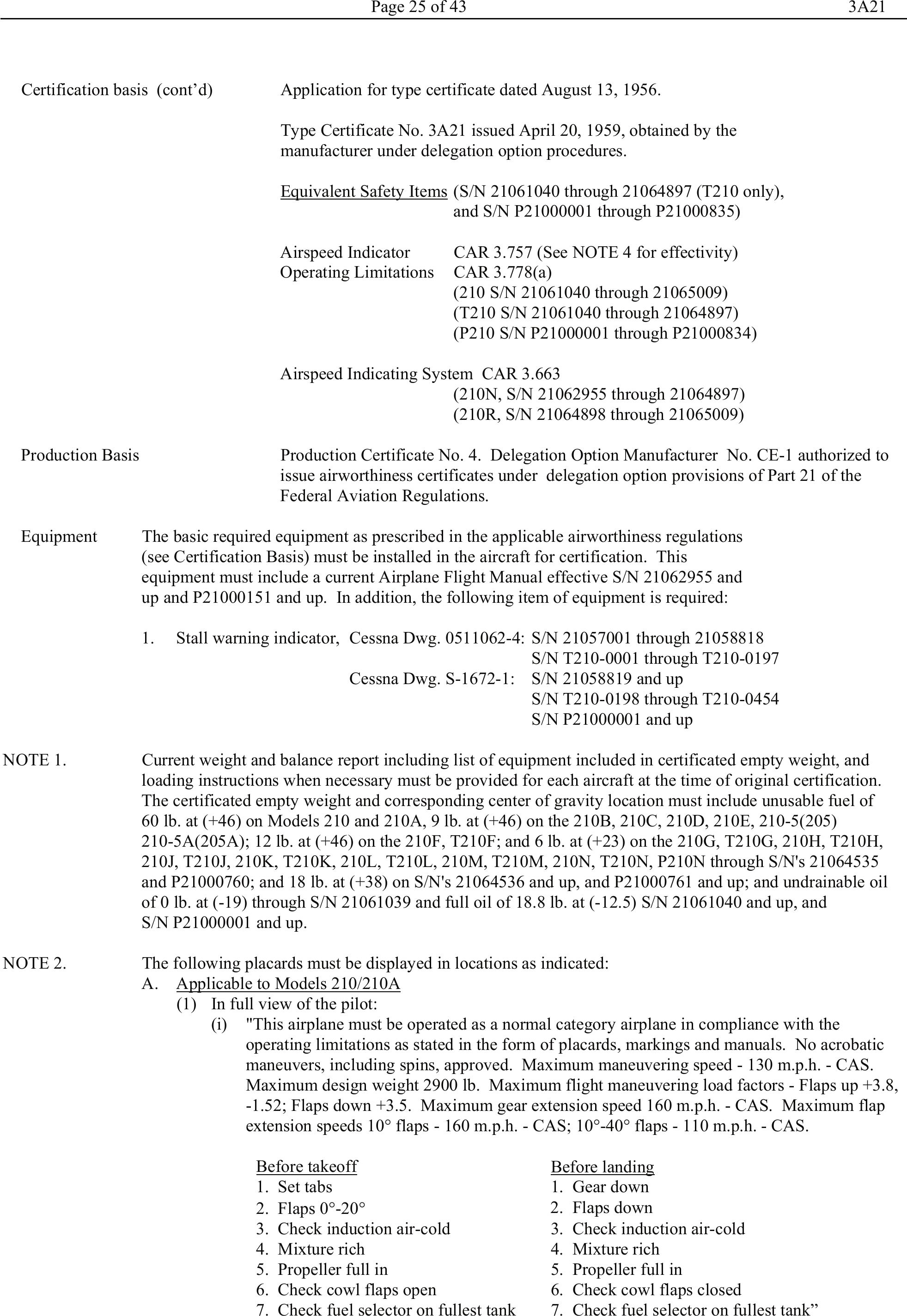
(Refer to the Type Certificate Data Sheet excerpt.) What is the location for weight and balance purposes of any unusable fuel on Cessna model 210 serial number 21058713?
- +23.
- +48.
- +46. ✓
Why: Serial 21058713 falls in the 210E range, and NOTE 1 states that the certificated empty weight and corresponding centre of gravity location must include unusable fuel of 9 lb. at (+46) on the 210B, 210C, 210D, 210E and the 210-5 models. The +23 station belongs to the later 210G through 210N group, and +48 is where the wing tanks themselves sit rather than the unusable fuel arm.
Where should a mechanic obtain the minimum bend radius for the alloy and thickness being formed?
- From the minimum bend radius table for that alloy, temper and thickness, which is found in the manufacturer's maintenance manual ✓
- From a standard value of two times the material thickness, which is conservative for every aluminium alloy in common use
- From the setback chart in the structural repair manual, which gives the radius and the setback together for each bend angle
Why: The handbook's instruction is to always use a minimum bend radius table for the alloy that is going to be used, and it says those charts are found in manufacturers' maintenance manuals. The reason is that the figure depends on temper and thickness as well as alloy, and the published tables do not agree with one another - AC 43.13-1B table 4-6 gives 2t to 4t for .032 inch 2024-T3, while the chart reproduced at figure 4-124 of the Airframe handbook gives .12 inch for the same material. A radius that is too sharp cracks the material as it is formed.
What is the total developed width of a formed part, and how does it compare with the sum of the mould line dimensions?
- The width measured around the bends from edge to edge, which is less than the sum of the mould line dimensions ✓
- The width measured around the bends from edge to edge, which is greater than the sum of the mould line dimensions
- The sum of the flats only, which equals the sum of the mould line dimensions less one setback for each bend
Why: Total developed width is what has to be cut, and it is found by adding the flats and the bend allowances. It comes out smaller than the sum of the mould line dimensions because the part bends on a radius instead of turning a square corner. The handbook suggests checking that relationship as a sanity test on the layout - a calculated TDW larger than the total of the mould line dimensions means an error somewhere.
Airworthiness Directives (AD's) may be issued to aircraft for which of the following categories?
- Primary, Standard, Ultralight, and Rotorcraft.
- Experimental, Restricted, Powered Lift, and Rotorcraft.
- Experimental, Standard, Primary and Restricted. ✓
Why: 39.3 makes ADs apply to products without carving out any airworthiness certificate category, so the correct option is the one naming four genuine certificate categories. Ultralights are not certificated aircraft at all - they operate under Part 103 - and powered-lift and rotorcraft are aircraft categories rather than classes of airworthiness certificate.
How much flattening is acceptable in the bend of a replacement metal tube?
- None at all, since any flattening reduces the flow area and raises the pressure drop across the bend
- Up to half the original outside diameter, provided the tube is annealed after forming to relieve the stress
- A small amount, provided the flattened dimension does not go below 75 percent of the original outside diameter ✓
Why: The circular accepts a small amount of flattening and puts the limit at 75 percent of the original outside diameter, because excessive flattening causes fatigue failure of the tube. The minimum bend radii are separately tabulated at table 9-2, by tubing size and by material, and a bend tighter than that is not cured by the tube surviving the forming.