FAA Part 107 Remote Pilot (UAG) Knowledge Test, Practice Exams
Revision Mode
Revise with instant feedback: the moment you pick an answer you see whether it was right, with the handbook-cited explanation. Untimed — ideal before you sit a mock test. Questions you miss keep coming back until you know them.
Exam Mode
Test-day conditions: no feedback until you submit, each knowledge area scored separately, with a full question-by-question review at the end.
The real test requires 70% to pass. Each knowledge area is scored separately here so you know exactly where you stand.
Knowledge areas & your progress
Unlock the full question bank
The free sample is one full practice exam's worth of questions, with at least 5 in every knowledge area so you can revise each topic: 95 questions in all. The full bank covers every knowledge area in depth, with source-cited explanations. $49, one time, lifetime access on up to 3 devices — all five tests (Mechanic General, Airframe, Powerplant, Part 107 Remote Pilot, and Inspection Authorization) included.
✓ One purchase, every written test · up to 3 devices · no subscription · no account needed
Score history
The real exam: key facts
| Delivered by | PSI |
|---|---|
| Official exam | Unmanned Aircraft General – Small (UAG) |
| Questions | 60 |
| Time | 2 hours |
| Passing score | 70% |
| Pre-licensing or eligibility | No instructor endorsement or written authorisation needed; obtain an FTN by creating an IACRA profile before registering. Minimum test age 14 (matrix); the Remote Pilot Certificate itself requires age 16 (14 CFR 107.61). |
| Book your exam | faa.psiexams.com/faa/login |
Checked 11 October 2026 from the official sources below. Rules and fees change, so confirm with PSI before you book.
How Hangar Prep compares
Hangar is a $49 question bank covering five FAA knowledge tests, not a ground school. Here is how it compares with the test prep candidates usually consider, including where they are the better choice. See the comparison with Gleim Aviation, ASA Prepware, King Schools and others.
Reviews
Review
Frequently asked questions
How is the FAA Part 107 Remote Pilot (UAG) Knowledge Test structured?
The real Unmanned Aircraft General - Small written test has 60 multiple-choice questions (3 options each), a 2-hour time limit, and requires 70% to pass. Questions are drawn across 19 knowledge areas. These follow the FAA-S-ACS-10 blueprint, and this bank mirrors those areas and their weights.
What score do I need to pass?
70 percent. Revise each knowledge area to that level in Revision Mode, then run the full exam simulation in Exam Mode before your test date.
Are these real FAA exam questions?
The live test bank is not published. Our questions include the FAA's own published sample questions plus original questions written to the FAA-S-ACS-10 blueprint and grounded in 14 CFR parts 89 and 107, AC 107-2A, the Remote Pilot Study Guide, the Pilot's Handbook of Aeronautical Knowledge and the AIM, with the source cited in each explanation.
How many practice questions are included?
The full Unmanned Aircraft General - Small bank contains 592 questions with explanations. The free sample is one full practice exam's worth of questions, with at least 5 in every knowledge area so you can revise each topic: 95 questions in all.
What else does the Part 107 certificate need?
The UAG knowledge test is the only exam. Pass it, then apply through IACRA for the Remote Pilot Certificate; there is no oral or practical. A certificate holder must also complete free recurrent training every 24 calendar months.
What does access cost?
$49, one time, for lifetime access to every test on the site and everything we add later. No subscription.
Can I use it on more than one device?
Yes. One purchase works on up to 3 of your devices. Your progress is saved on each device.
Do I need to create an account?
No. The practice tests run in your browser with no signup. Your score history is saved on your own device.
What topics does the FAA Part 107 Remote Pilot (UAG) Knowledge Test question bank cover?
It is organised into 19 modules that follow the exam's own content areas: Regulations: operating rules and limitations, Operations over human beings, Remote identification, Regulations: applicability, definitions and reporting, Regulations: certification, recency and waivers, Regulations: alcohol and drugs, Airspace classification, Potential flight hazards, Airspace operating requirements, Lighting and ground hazards, Effects of weather on performance, Weather sources and reports, Loading, balance and performance, Airport operations, Emergency procedures, Physiology and fitness for flight, Radio communication procedures, Aeronautical decision-making and Maintenance and preflight inspection. Each module is drilled and scored separately, so you can see exactly which areas are exam-ready and which still need work.
When was this question bank last updated?
Last updated 15 September 2026. The bank is revised whenever the source material it cites changes, and every question carries the source its explanation is drawn from.
Sample FAA Part 107 Remote Pilot (UAG) Knowledge Test practice questions
A selection of free questions with answers and explanations. Use the interactive modules above for timed, scored drills.
A declaration of compliance is
- a record filed with the FAA certifying it meets Category 2 or 3 ✓
- an entry the remote PIC makes in the aircraft log before each flight
- a placard the remote pilot fixes to the airframe before flight
Why: A declaration of compliance is a record submitted to the FAA certifying that the small unmanned aircraft conforms to the Category 2 or Category 3 requirements of subpart D. The aircraft must be listed on an FAA-accepted declaration to be operated in those categories. 14 CFR 107.3 and 107.160.
A Category 2 aircraft has its propellers replaced with a type listed as an allowed modification in the remote pilot operating instructions. Is a new Declaration of Compliance needed?
- Yes, because a new declaration is required whenever any maintenance is performed on the aircraft
- No, because a maintenance action that does not change the configuration needs no new declaration ✓
- Yes, because any replacement of a rotating part requires a fresh declaration to be submitted
Why: Maintenance actions that do not change the configuration or characteristics of an eligible Category 2 or 3 aircraft do not require a new DOC. Replacing propellers listed as an allowed modification in the remote pilot operating instructions is the FAA's own example.
An aircraft with no remote identification equipment at all may be flown only
- when a visual observer in radio contact is stationed nearby
- within the boundaries of an FAA-recognized identification area ✓
- below 100 feet AGL over property the operator owns or leases
Why: Operating without remote identification equipment is permitted only where the aircraft and the person at the controls both remain within the boundaries of an FAA-recognized identification area throughout the flight, and that person can see the aircraft at all times. 14 CFR 89.115(b).
Show more sample questions with answers & explanations
What effect can illumination from a laser operation have on a pilot?
- Temporary radio interference on VHF frequencies, but no effect on the pilot's vision
- Temporary disruption of the magnetic compass, which recovers again once the beam has passed by
- Temporary vision impairment miles from the actual location, and possibly permanent eye damage ✓
Why: Pilots should be aware that illumination from laser operations is able to create temporary vision impairment miles from the actual location. In addition, these operations can produce permanent eye damage. Pilots should make themselves aware of such activities and avoid those areas. AIM 7-6-13.
Under part 107, ADS-B Out equipment on a small unmanned aircraft
- is required equipment for any operation conducted at night
- must be operated in transmit mode when in Class B, C or D airspace
- may not be operated in transmit mode unless otherwise authorized ✓
Why: Unless otherwise authorized by the Administrator, no person may operate a small UAS under part 107 with ADS-B Out equipment in transmit mode. The prohibition exists to avoid saturating the system with UAS targets. 14 CFR 107.53.
When must the remote pilot in command check NOTAMs?
- Only when the operation will be conducted within controlled airspace
- Before each flight, to determine whether any airspace restrictions apply to the operation ✓
- Once every 28 days, to match the NOTAM system's own publication cycle
Why: Certain TFRs may be imposed by way of a NOTAM. The remote PIC must check for NOTAMs before each flight to determine whether any airspace restrictions apply to the operation.
Which of these is a reported symptom of precipitation static?
- Complete loss of VHF communications, and magnetic compass readings in error by up to 30 per cent ✓
- Complete loss of engine power, and a gradual loss of the cabin pressurisation while at altitude
- Complete loss of GPS position, and an uncommanded deployment of the landing gear
Why: Reported P-static problems include complete loss of VHF communications, erroneous magnetic compass readings in error by 30 per cent, a high pitched squeal or motor boat sound on audio, erratic instrument readouts, weak transmissions, and St Elmo's fire on the windshield. AIM 7-6-12.
When selecting an operational area for a flight near uninvolved people, the remote PIC should prioritise
- an area where mobile phone coverage is strongest for the control link
- an area where the aircraft can be kept clear of people who are not participating ✓
- an area with the shortest possible drive from the client's premises
Why: Site selection is a risk control. The preflight assessment must consider the location of persons and property on the surface, and the operating area should be chosen so the aircraft can be kept away from people who are not directly participating. 14 CFR 107.49(a)(3); AC 107-2A ch.5.
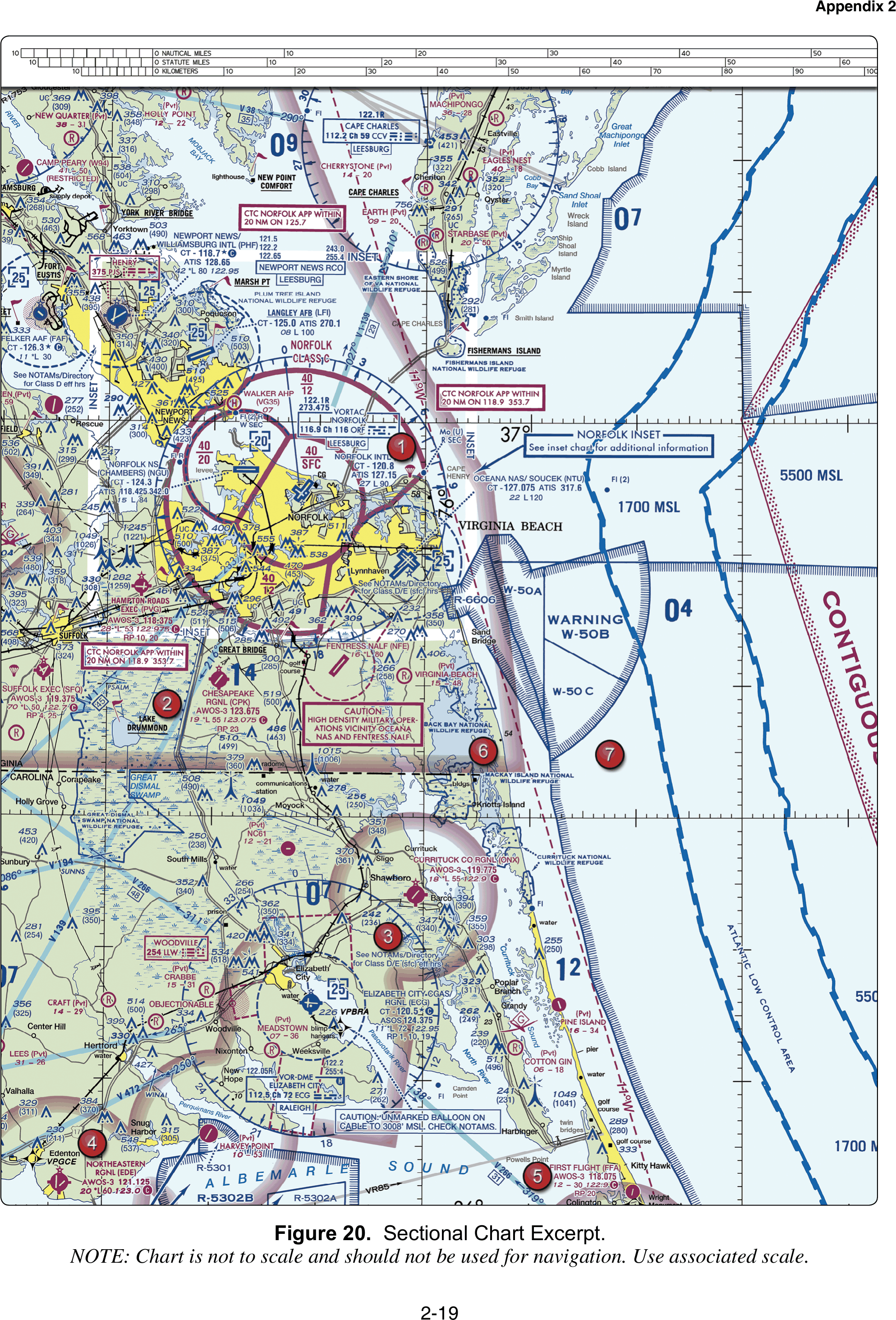
(Refer to FAA-CT-8080-2H, Appendix 2, Figure 20.) The chart shows an area labelled R-6606. What does the R prefix identify?
- A reporting point, at which position reports are made to ATC
- A restricted area, within which flight is subject to restrictions ✓
- A prohibited area, within which the flight of aircraft is prohibited
Why: Restricted areas are charted with an R followed by a number. They contain unusual, often invisible hazards such as artillery firing or guided missiles, and flight within them is not wholly prohibited but is subject to restrictions. A prohibited area carries a P prefix.
How does air density vary with pressure, at a constant temperature?
- Density is directly proportional to pressure, so halving the pressure halves the density ✓
- Density is inversely proportional to pressure, so halving the pressure doubles the density
- Density is independent of pressure, since only temperature and humidity change it
Why: Density is directly proportional to pressure. If the pressure is doubled the density is doubled, and if the pressure is lowered so is the density. This statement is true only at a constant temperature.
Can an aircraft be stalled at any airspeed?
- No, a stall can occur only at or below the published unaccelerated stalling speed
- No, a stall occurs once engine power has been reduced to idle while in level flight
- Yes, within the limits of its structure, whenever a sufficiently high angle of attack is imposed ✓
Why: Any aircraft, within the limits of its structure, may be stalled at any airspeed. When a sufficiently high angle of attack is imposed the smooth flow of air over an airfoil breaks up and separates, producing an abrupt change of flight characteristics and a sudden loss of lift.
A remote pilot plans a flight from a high-elevation site on a hot, humid afternoon at maximum gross weight. What should the pilot do?
- Reduce the weight carried, because those conditions all raise density altitude and cut performance ✓
- Increase the planned altitude, because the thinner air reduces the drag the aircraft must overcome
- Proceed as planned, because the maximum gross weight already accounts for the site's elevation
Why: Conditions that affect takeoff and climb performance, such as high elevations, high air temperatures and high humidity, all of which mean high density altitude, may require a reduction in weight before flight is attempted. Launch area length, surface, slope and obstacles may require it too.
How do the terms hazard and risk differ in aeronautical decision-making?
- A hazard is a condition the pilot can control; risk is a condition outside the pilot's control
- A hazard is a weather phenomenon; risk is any equipment defect found during the preflight check
- A hazard is a condition or event encountered; risk is the pilot's assessment of its potential impact ✓
Why: Hazard is a real or perceived condition, event or circumstance that a pilot encounters. The pilot assigns a value to the potential impact of that hazard, and that assessment is the risk. Different pilots may see the same hazard differently.
A local police officer asks a remote pilot who is actively flying to produce their remote pilot certificate. The remote pilot must
- forward it to the responsible Flight Standards office within 10 days
- present it only where the officer is acting on a written FAA request
- present it, having had it in physical possession and readily accessible ✓
Why: A remote pilot exercising the privileges of the certificate must have it in physical possession and readily accessible, and must present it with identification on request from the Administrator, an NTSB representative, any Federal, State or local law enforcement officer, or a TSA representative. 14 CFR 107.7.
When must a remote pilot in command be designated?
- At least 24 hours before the flight
- Only when a visual observer is used
- Before or during the flight ✓
Why: A remote pilot in command must be designated before or during the flight of the small unmanned aircraft, and is directly responsible for and the final authority as to the operation. 14 CFR 107.19(a) and (b).
How many unmanned aircraft may one person operate at the same time under part 107?
- Two, provided both of them remain within visual line of sight of a single visual observer
- Any number, provided each aircraft has its own dedicated visual observer
- One, since a person may not manipulate the controls of more than one aircraft at a time ✓
Why: A person may not manipulate flight controls or act as a remote pilot in command or visual observer in the operation of more than one unmanned aircraft at the same time. 14 CFR 107.35.
Who may apply to establish an FAA-recognized identification area?
- The owner or operator of any private airfield or model flying site
- Any holder of a remote pilot certificate with a small UAS rating
- A recognized community-based organization, or an educational institution ✓
Why: Only a community-based organization recognized by the Administrator, or an educational institution such as a school, trade school, college or university, is eligible to apply for an FAA-recognized identification area. 14 CFR 89.205.
What does AC 107-2A recommend for determining the type of airspace over an intended operating area?
- Telephoning the nearest air traffic control facility during its published hours of operation
- Consulting the most recent Chart Supplement U.S. entry for the nearest public-use airport
- Referring to the B4UFly app or a current aeronautical chart of the intended operating area ✓
Why: Remote PICs must be aware of the type of airspace in which they will be operating. Referring to the B4UFly app or a current aeronautical chart of the intended operating area will aid the remote pilot's decision making regarding operations in the National Airspace System.
A remote pilot refuses a law enforcement officer's request for a blood alcohol test. This refusal is
- a matter for the State authorities alone, with no FAA consequence
- within the pilot's rights, part 107 containing no testing provision
- grounds for denial for up to 1 year, or suspension or revocation ✓
Why: Refusing a test requested in accordance with 14 CFR 91.17(c), or refusing to furnish or authorize release of the results, is itself grounds for denial of an application for up to 1 year or for suspension or revocation. 14 CFR 107.59.
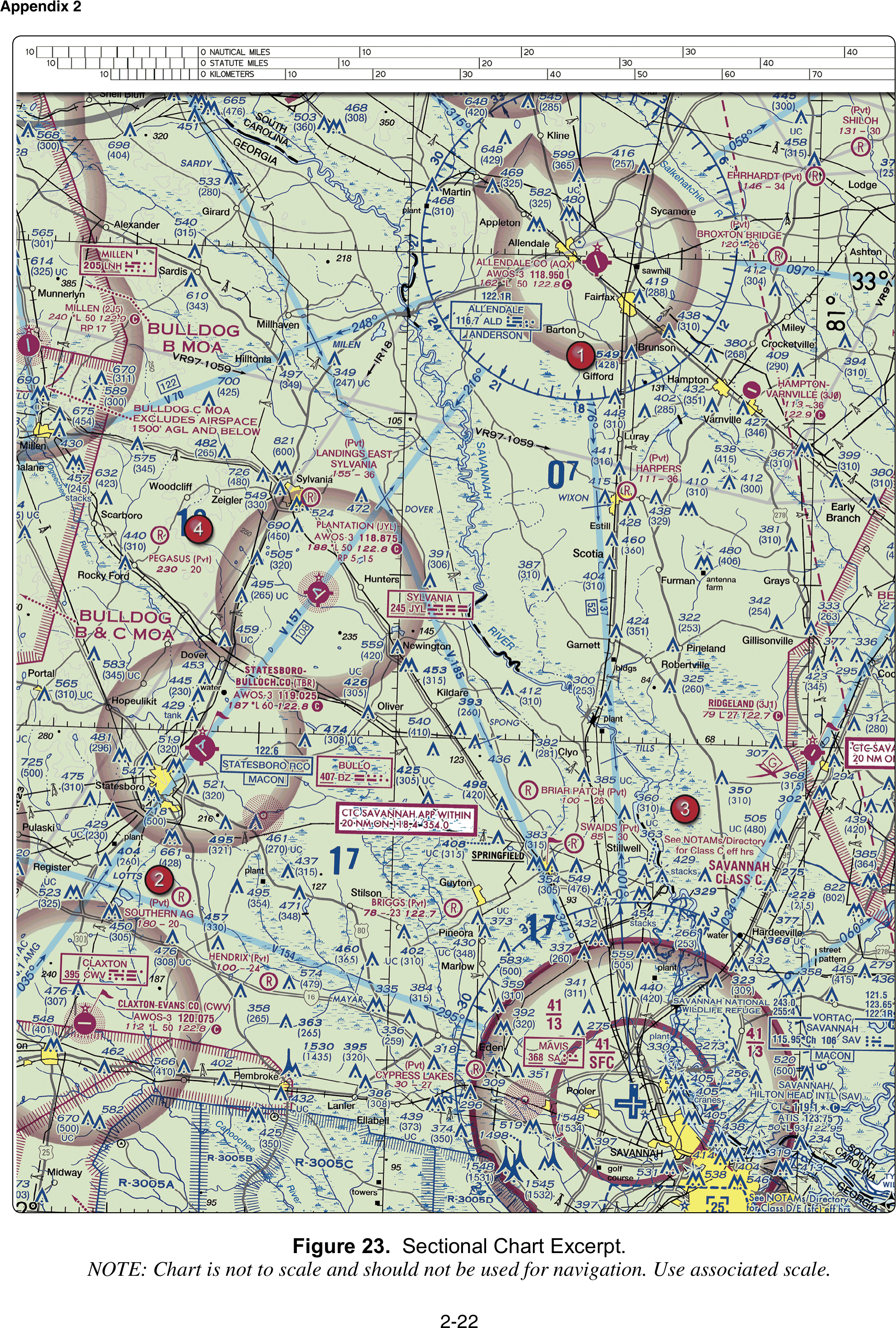
(Refer to FAA-CT-8080-2H, Appendix 2, Figure 23.) A small star sits immediately above the Allendale Co (AQX) airport symbol. What does the star depict?
- An airport whose runway lights are available only in daylight hours
- A rotating airport beacon in operation from sunset to sunrise ✓
- A lighted obstruction standing on the airport boundary itself
Why: The legend's airport block ends with a star against the words rotating airport beacon in operation Sunset to Sunrise. A separate star, printed inline within a data block rather than above a symbol, means something else entirely - that the facility beside it operates part time.
(Refer to FAA-CT-8080-2H, Appendix 2, Figure 20.) The CAUTION box warning of the unmarked balloon ends with the words CHECK NOTAMS. How would a remote pilot do that?
- By consulting the chart legend printed on the reverse of the sectional
- By obtaining a briefing from an online source such as 1800wxbrief.com ✓
- By telephoning the nearest Flight Standards District Office
Why: Remote PICs are encouraged to obtain a briefing from Flight Service through 1800wxbrief.com, and must check for NOTAMs before each flight to determine whether any airspace restrictions apply. The chart legend carries no time-critical information of this kind.
Which of these is one of the four ways air can reach its saturation point?
- Warm air moving over a cold surface, which drops the air temperature to the dew point ✓
- Cold air sinking through warmer air, which compresses it and raises the dew point
- Dry air passing over a mountain range, which strips water vapour out of the air
Why: The four methods are: warm air moving over a cold surface so its temperature drops to saturation; cold air and warm air mixing; air cooling at night through contact with the cooler ground; and air being lifted or forced upward in the atmosphere.
Which check does the FAA recommend at a controlled low altitude during the preflight sequence?
- Flying to the maximum permitted altitude to confirm the altimeter reads correctly
- Flying within range of any interference and rechecking all controls and stability ✓
- Flying a full circuit of the operating area to confirm the battery endurance figure
Why: The recommended preflight items include starting the propellers to inspect for imbalance or irregular operation, and then, at a controlled low altitude, flying within range of any interference and rechecking all controls and stability.
Which of these is a purpose for establishing a temporary flight restriction?
- To protect persons and property from an existing or imminent hazard on the surface or in the air ✓
- To reserve airspace for those military training activities that must be kept clear of IFR traffic
- To provide a permanent buffer around airports that have an operational control tower
Why: Purposes for establishing a TFR include protecting persons and property from an existing or imminent hazard, providing a safe environment for disaster relief aircraft, preventing unsafe congestion of sightseeing aircraft, and protecting the President, Vice President or other figures.
A small unmanned aircraft eligible for Category 2 operations must carry
- a label indicating its eligibility to conduct Category 2 operations ✓
- a placard showing the accepted means of compliance reference number
- a copy of the declaration of compliance in a weatherproof holder
Why: The applicant must display a label on the aircraft indicating eligibility to conduct Category 2 operations, and the aircraft must be listed on an FAA-accepted declaration of compliance. 14 CFR 107.120(b)(1) and 107.115(a).
In flight, a standard remote identification aircraft stops broadcasting its message elements. The person at the controls must
- continue the flight but file a report within 10 calendar days
- switch to the aircraft's ADS-B Out equipment for the remainder
- land the unmanned aircraft as soon as practicable ✓
Why: If a standard remote identification unmanned aircraft is no longer broadcasting the message elements of 89.305, the person manipulating the flight controls must land it as soon as practicable. ADS-B Out may not be used to satisfy remote ID. 14 CFR 89.110(a)(2).
What blood alcohol concentration disqualifies a person from acting as remote PIC?
- .02 percent or greater
- .04 percent or greater ✓
- .08 percent or greater
Why: A blood alcohol concentration of .04 percent or greater disqualifies a person, independently of the 8-hour rule and of whether they feel impaired. 14 CFR 91.17 as applied by 107.27; AC 107-2A ch.5.
What must a request for a certificate of waiver contain?
- A complete list of the crew members with their remote pilot certificate numbers and their issue dates
- A complete description of the proposed operation and a justification that it can be conducted safely ✓
- A complete maintenance history of the aircraft and the results of its most recent inspection
Why: A request for a certificate of waiver must contain a complete description of the proposed operation and justification that establishes that the operation can safely be conducted under the terms of a certificate of waiver. 14 CFR 107.200(b).
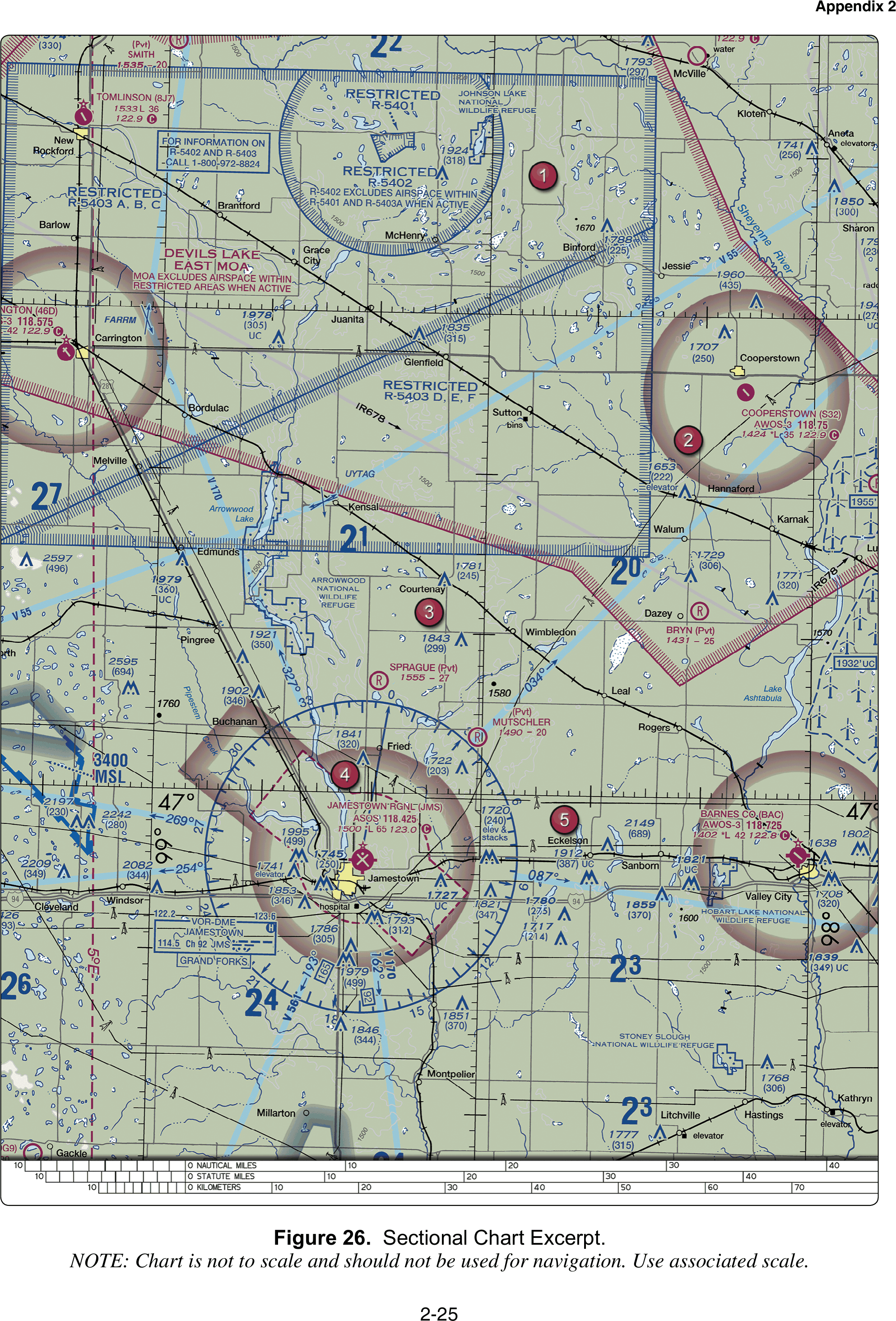
(Refer to FAA-CT-8080-2H, Appendix 2, Figure 26.) A note on this chart reads R-5402 EXCLUDES AIRSPACE WITHIN R-5401 AND R-5403A WHEN ACTIVE. What does it tell you?
- When those areas are active their airspace is not part of R-5402 ✓
- R-5402 may not be entered at any time that R-5401 or R-5403A is active
- R-5402 is the controlling area and the other two are subordinate to it
Why: The note resolves an overlap between three numbered restricted areas by carving the active ones out of R-5402. The chart states the relationship in plain words, which is the point of the note.
Under the rules part 107 adopts, a person may not act as remote PIC within how long of consuming an alcoholic drink?
- 8 hours ✓
- 12 hours
- 24 hours
Why: Part 107 requires compliance with 14 CFR 91.17, under which a person may not act as a crewmember within 8 hours of consuming any alcoholic beverage, while under the influence, with a blood alcohol concentration of .04 percent or greater, or while using an impairing drug. AC 107-2A ch.5.
Whose responsibility is it to ensure that no crew member is impaired during an operation?
- The remote pilot in command, who must ensure all crew members are unimpaired ✓
- Each individual crew member, who must self-certify their fitness before the flight
- The operator's safety manager, who must record each crew member's declaration
Why: Part 107 does not allow operation of a small UAS if the remote PIC, person manipulating the controls or visual observer is unable to carry out their responsibilities safely. It is the remote PIC's responsibility to ensure all crew members are not impaired. 14 CFR 107.27.
Which components should maintenance recordkeeping cover?
- The aircraft, control station, launch and recovery equipment, C2 link equipment and payload ✓
- The airframe and the propulsion system, since these are the flight-critical parts
- Only those components the manufacturer has assigned a time-in-service limit to
Why: Recordkeeping would include all components of the small UAS: the small unmanned aircraft, control station, launch and recovery equipment, command and control link equipment, payload, and any other component required to operate the small UAS safely.
Which of these regulations may a certificate of waiver authorise a deviation from?
- 14 CFR 107.49, preflight familiarisation and inspection, which appears on the waiver list
- 14 CFR 107.41, operation in certain airspace, which appears on the waiver list ✓
- 14 CFR 107.17, medical condition, which appears on the waiver list
Why: The list of regulations subject to waiver covers 107.25, 107.29(a)(2) and (b), 107.31, 107.33, 107.35, 107.37(a), 107.39, 107.41, 107.51 and 107.145. The medical condition and preflight inspection rules are not on it. 14 CFR 107.205.
What practical benefit does the FAA attribute to maintenance recordkeeping?
- It transfers responsibility for the aircraft's condition to the maintenance provider
- It helps track component service life and reveals systemic failure patterns over time ✓
- It satisfies the part 107 requirement for an annual inspection of the small UAS
Why: Methodical maintenance and inspection data collection can prove very helpful in tracking small UAS component service life, as well as systemic component, equipage and structural failure events. It also reinforces owner and operator responsibility.
What must the pilot of the aircraft experiencing the emergency not do during an airborne inspection?
- Divert to an alternate airport until the inspection has been formally terminated by ATC
- Relinquish control of the situation or jeopardise the safety of their own aircraft ✓
- Communicate with the inspecting aircraft on any frequency other than 121.5 MHz
Why: The pilot in command of the aircraft experiencing the problem must not relinquish control of the situation and/or jeopardise the safety of their aircraft. The manoeuvre must be accomplished with minimum risk to both aircraft. AIM 7-6-11.
Why must the remote pilot consider the consequences of an overweight aircraft before flight?
- Because an overweight aircraft leaves less safety margin if an emergency condition then arises ✓
- Because an overweight aircraft must be reported to the FAA within ten days of the flight
- Because an overweight aircraft requires a certificate of waiver from the FAA before flight
Why: Excessive weight in itself reduces the safety margins available to the pilot and becomes even more hazardous when combined with other performance-reducing factors. The remote PIC must consider the consequences of an overweight aircraft if an emergency condition arises.
Besides the kinetic energy threshold, a Category 2 or Category 3 aircraft must have
- a maximum takeoff weight of no more than 0.55 pounds when loaded
- no exposed rotating parts that would lacerate skin, and no safety defects ✓
- a manufacturer's airworthiness certificate issued under 14 CFR part 21
Why: Both categories require that the aircraft has no exposed rotating parts that would lacerate human skin on impact and contains no safety defects. The part 21 certificate belongs to Category 4 and the 0.55-pound limit to Category 1. 14 CFR 107.120(a) and 107.130(a).
What limits the amount of lift an airfoil can produce?
- The propeller diameter, the motor's rated power and the control station's range
- The airfoil's design, the angle of attack, the airspeed and the density of the air ✓
- The aircraft's registered weight, its rated payload capacity and its battery endurance
Why: The amount of lift produced by an airfoil is limited by the airfoil design, angle of attack, airspeed and air density. To ensure the lift generated is sufficient to counteract weight, loading beyond the manufacturer's recommended weight must be avoided.
What area does a terminal aerodrome forecast cover?
- A five statute mile radius around the airport for which it is issued ✓
- A ten nautical mile radius around the airport for which it is issued
- The whole of the flight information region in which the airport lies
Why: A TAF is a report established for the five statute mile radius around an airport. TAF reports are usually given for larger airports and are valid for a 24 or 30-hour period.
What is low-level wind shear commonly associated with?
- Passing frontal systems, thunderstorms, temperature inversions and strong upper level winds ✓
- Clear, calm mornings with a light surface breeze and unlimited visibility
- Stable air masses that have remained over the same region for several days
Why: Low-level wind shear is especially hazardous because of the aircraft's proximity to the ground. It is commonly associated with passing frontal systems, thunderstorms, temperature inversions and strong upper level winds greater than 25 knots.
What relationship does lightning frequency have to the severity of a storm?
- A direct proportional relationship, so the lightning count gives the storm's intensity precisely
- An inverse relationship, so the most severe storms produce the least frequent lightning
- No simple relationship to other storm parameters, though severe storms as a rule have frequent lightning ✓
Why: Though lightning intensity and frequency have no simple relationship to other storm parameters, severe storms, as a rule, have a high frequency of lightning. PHAK ch.12.
A remote identification broadcast module must broadcast the position of
- the nearest airport reference point to the operation
- the control station being used for the flight
- the take-off location of the unmanned aircraft ✓
Why: A broadcast module broadcasts the latitude, longitude and geometric altitude of the take-off location, because it has no connection to the control station. A standard remote identification aircraft broadcasts control station position instead. 14 CFR 89.315(e) and (f).
A remote pilot's last recurrent training was 26 calendar months ago. May that pilot act as remote PIC today?
- Yes, because the certificate itself does not expire and recency applies only to commercial work
- Yes, because the 24-month period runs from the certificate's issue date rather than the training
- No, because the recency requirement must have been met within the previous 24 calendar months ✓
Why: A person may not exercise the privileges of a remote PIC with a small UAS rating unless one of the listed recency items has been accomplished within the previous 24 calendar months. At 26 months the privileges may not be exercised until recency is restored. 14 CFR 107.65.
Which checklists accompany each step of the 3P model?
- CARE to perceive hazards, TEAM to process them, and IMSAFE to perform risk management
- PAVE to perceive hazards, CARE to process them, and TEAM to perform risk management ✓
- IMSAFE to perceive hazards, PAVE to process them, and DECIDE to perform risk management
Why: The six steps of risk management combine into the 3P model with three checklists: pilots perceive hazards using PAVE, process hazards using CARE, which is Consequences, Alternatives, Reality and External factors, and perform risk management using TEAM: Transfer, Eliminate, Accept or Mitigate.
What do the letters of the IMSAFE checklist stand for?
- Illness, medication, stress, alcohol, fatigue and emotion ✓
- Inspection, maintenance, systems, airspace, fuel and equipment
- Intent, mission, safety, airspace, forecast and endurance
Why: IMSAFE is a personal self-assessment checklist standing for Illness, Medication, Stress, Alcohol, Fatigue and Emotion. It is one of the best ways a single pilot can mitigate risk by determining physical and mental readiness for flying.
Which part 61 certificate does NOT open the training route to a remote pilot certificate?
- A commercial pilot certificate, which requires a separate knowledge test instead
- A student pilot certificate, which the rule expressly excludes from that route ✓
- A private pilot certificate, which does not satisfy the flight review requirement
Why: The alternative route is open to a person who holds a pilot certificate other than a student pilot certificate issued under part 61 and who meets the flight review requirements of 61.56. The student pilot certificate is the one expressly carved out. 14 CFR 107.61(d)(2).
Which small UAS operating frequencies may be used freely without obtaining an FCC licence?
- 900 MHz, 2.4 GHz and 5.8 GHz, which are unlicensed bands open to any civil user ✓
- Any frequency below 1 GHz, provided the transmitter power is under one watt
- Any frequency at all, because unmanned aircraft are wholly exempt from FCC licensing
Why: Some operating frequencies are unlicensed and can be used freely, for example 900 MHz, 2.4 GHz and 5.8 GHz, without FCC approval. All other frequencies require a user-specific licence from the FCC for civil users other than federal agencies.
A remote pilot sees an aircraft's landing light below 10,000 feet in daylight near an airport. Why is it on?
- Operation Lights On, a voluntary FAA programme encouraging landing lights to enhance see-and-avoid ✓
- A regulatory requirement that landing lights be used below 10,000 feet within 10 miles of an airport
- An indication that the aircraft has declared an emergency and requires priority handling
Why: The FAA has a voluntary pilot safety programme, Operation Lights On, to enhance see-and-avoid. Pilots are encouraged to turn on landing lights during takeoff and when operating below 10,000 feet day or night, especially within 10 miles of an airport or where flocks of birds may be expected. AIM 4-3-24.
When must a manned aircraft equipped with an anti-collision light system operate that system?
- During operations in controlled airspace, where other traffic is more likely to be present
- During all types of operations, by day and by night, unless the PIC judges it a hazard to safety ✓
- During night operations only, since by day the lights add nothing to see-and-avoid
Why: Aircraft equipped with an anti-collision light system are required to operate that system during all types of operations, day and night. In adverse meteorological conditions the PIC may determine the lights should be off where their output would be a hazard to safety. AIM 4-3-24, 14 CFR 91.209.
To conduct Category 1 operations over human beings, the small unmanned aircraft must weigh
- 0.55 pounds or less on takeoff and throughout the operation ✓
- less than 4.4 pounds on takeoff, including any attached payload
- 0.55 kilograms or less, measured without the payload fitted
Why: Category 1 requires an aircraft weighing 0.55 pounds or less on takeoff and throughout the operation, including everything on board or attached, and with no exposed rotating parts that would lacerate human skin. 14 CFR 107.110(a).
(Refer to FAA-CT-8080-2H, Appendix 2, Figure 20.) A second CAUTION box on this chart warns of what hazard in the vicinity of Oceana NAS and Fentress NALF?
- Unmarked balloons on cables
- Uncharted antenna towers over 1,000 feet AGL
- High density military operations ✓
Why: The box reads CAUTION: HIGH DENSITY MILITARY OPERATIONS VICINITY OCEANA NAS AND FENTRESS NALF. A caution box states its hazard in plain words, which is why reading the box itself is the whole of the task.
What may a manned aircraft's anti-collision light system consist of?
- A single rotating beacon, which must always be red rather than white
- A pair of synchronised strobes on the wingtips, which are white in colour
- One or more rotating beacons and/or strobe lights, coloured either red or white ✓
Why: An aircraft anti-collision light system can use one or more rotating beacons and/or strobe lights, be coloured either red or white, and have different intensities compared with other aircraft. Many aircraft have both a rotating beacon and a strobe light system. AIM 4-3-24.
How is the registration number N123AB spoken in a radio transmission using the phonetic alphabet?
- November One-Twenty-Three-Alpha-Bravo, with the make or model replacing November
- November One-Two-Three-Able-Baker, with the make or model never replacing November
- November One-Two-Three-Alpha-Bravo, with the make or model often replacing November ✓
Why: Every aircraft registered in the United States has a unique registration or N number. N123AB is pronounced November One-Two-Three-Alpha-Bravo. In most cases November is replaced by the manufacturer's name or, for heavier aircraft, the model.
Why are lithium-based batteries a particular emergency concern for small UAS?
- They are highly flammable and capable of ignition, and a fire can cause a loss of control in flight ✓
- They lose capacity gradually with age, so an older battery gives noticeably less endurance than a new one of the same type
- They are heavier than other chemistries, so they reduce the payload the aircraft can carry
Why: Lithium-based batteries are highly flammable and capable of ignition. A battery fire could cause an in-flight emergency by causing a loss of control of the small unmanned aircraft.
A temporary remote pilot certificate is issued for a period of up to
- 120 calendar days ✓
- 60 calendar days
- 24 calendar months
Why: A temporary remote pilot certificate with a small UAS rating is issued for up to 120 calendar days, after which a permanent certificate is issued to a person the Administrator finds qualified. 14 CFR 107.64(a).
Before operating a foreign registered unmanned aircraft in the United States, the operator must
- notify the ATC facility nearest to the intended operating area
- obtain a temporary United States registration certificate first
- submit a notice of identification to the FAA before the operation ✓
Why: No person may operate a foreign registered civil unmanned aircraft with remote identification in US airspace unless a notice of identification is submitted to the FAA before the operation, giving the operator's details, the aircraft make, model and serial number, and the country of registration. 14 CFR 89.130(a).
What may follow if a person without proper identification is observed entering a SIDA?
- An immediate suspension of the person's airman certificate by the control tower
- A report to the Transportation Security Administration or airport security, and possible fines ✓
- A note in the airport's own daily log, with no further consequence for a first occurrence
Why: Pilots or passengers without proper identification observed entering a SIDA may be reported to the Transportation Security Administration or airport security and may be subject to civil and criminal fines and prosecution. Pilots are advised to brief passengers accordingly. AIM 2-3-15.
Under 14 CFR part 107, what is the maximum weight of a small unmanned aircraft at takeoff?
- Less than 55 pounds, including everything on board or attached ✓
- Less than 55 pounds, excluding payload and attached equipment
- Less than 25 kilograms, excluding batteries and camera gear
Why: Part 107 defines a small unmanned aircraft as one weighing less than 55 pounds on takeoff, including everything that is on board or otherwise attached to the aircraft. Payload and batteries count toward the limit. 14 CFR 107.3.
A remote pilot has a hangover but has not drunk anything for 12 hours. What is that pilot's condition?
- The pilot is fit to operate, because more than 8 hours have elapsed since the last drink
- The pilot is fit to operate provided a second qualified crew member is present to check their decisions
- The pilot is still under the influence of alcohol, with motor and mental impairment still present ✓
Why: While experiencing a hangover a pilot is still under the influence of alcohol. Although the pilot may think they are functioning normally, motor and mental response impairment is still present. Considerable amounts of alcohol can remain in the body for over 16 hours.
What is the practical consequence of the 2.4 GHz and 5.8 GHz bands being line-of-sight?
- The link must be manually re-established by the operator each time the aircraft turns onto a different heading
- The command and control link will not work properly when a barrier lies between the station and the aircraft ✓
- The link range is unlimited in clear air but falls to zero as soon as the sun sets
Why: Both bands are considered line of sight, and the command and control link between the control station and the aircraft will not work properly when barriers are between them. The part 107 requirement to keep the aircraft in sight helps prevent such obstructions.
Which five hazardous attitudes have been identified as interfering with sound decision-making?
- Complacency, distraction, fixation, overconfidence and indecision
- Anxiety, fatigue, frustration, inattention and overcaution
- Anti-authority, impulsivity, invulnerability, macho and resignation ✓
Why: Studies have identified five hazardous attitudes that can interfere with the ability to make sound decisions and exercise authority properly: anti-authority, impulsivity, invulnerability, macho and resignation.
Roughly what share of aviation accidents is estimated to be related to human factors?
- About 40 per cent, with the majority of those occurring during the cruise phase
- About 15 per cent, with the majority of those occurring during preflight preparation
- About 80 per cent, with the majority of those occurring during landing and takeoff ✓
Why: It is estimated that approximately 80 per cent of all aviation accidents are related to human factors, and the vast majority of these accidents occur during landing, at 24.1 per cent, and takeoff, at 23.4 per cent.
Why should a remote pilot not rely on thirst as the signal to drink during a long summer operation?
- The thirst mechanism arrives too late and is switched off too easily by a small amount of fluid ✓
- The thirst mechanism is suppressed entirely by adrenaline whenever the pilot is concentrating
- The thirst mechanism responds to blood salt levels, so it gives little warning of water loss
Why: Most people become thirsty only at a 1.5 quart deficit or a loss of 2 per cent of body weight. The problem is that the thirst mechanism arrives too late and is turned off too easily: a small amount of fluid in the mouth switches it off and delays replacement of the fluid actually needed.
How long should a pilot wait after the first dose of any new medication before flying?
- At least 12 hours, or until the medication's stated half-life has fully elapsed
- At least 48 hours, to establish that there are no adverse side effects ✓
- At least 8 hours, which is the same interval that applies after drinking alcohol
Why: For any new medication, whether over-the-counter or prescribed, a pilot should wait at least 48 hours after the first dose before flying, to determine there are no adverse side effects that would make it unsafe to operate an aircraft.
A remote pilot monitoring the CTAF hears: "Town and Country traffic, Cessna 123 Bravo Foxtrot, left base, runway 18, Town and Country traffic." What does this tell the remote pilot?
- The aircraft has just departed runway 18 and is turning to leave the traffic pattern
- The aircraft is 10 miles from the field and is joining the downwind leg for runway 18
- The aircraft is on the pattern leg flown immediately before turning final approach to runway 18 ✓
Why: Base leg is flown between the downwind leg and final approach, so an aircraft calling left base for runway 18 is one turn from final. The remote pilot should expect it to descend towards the runway shortly and scan accordingly.
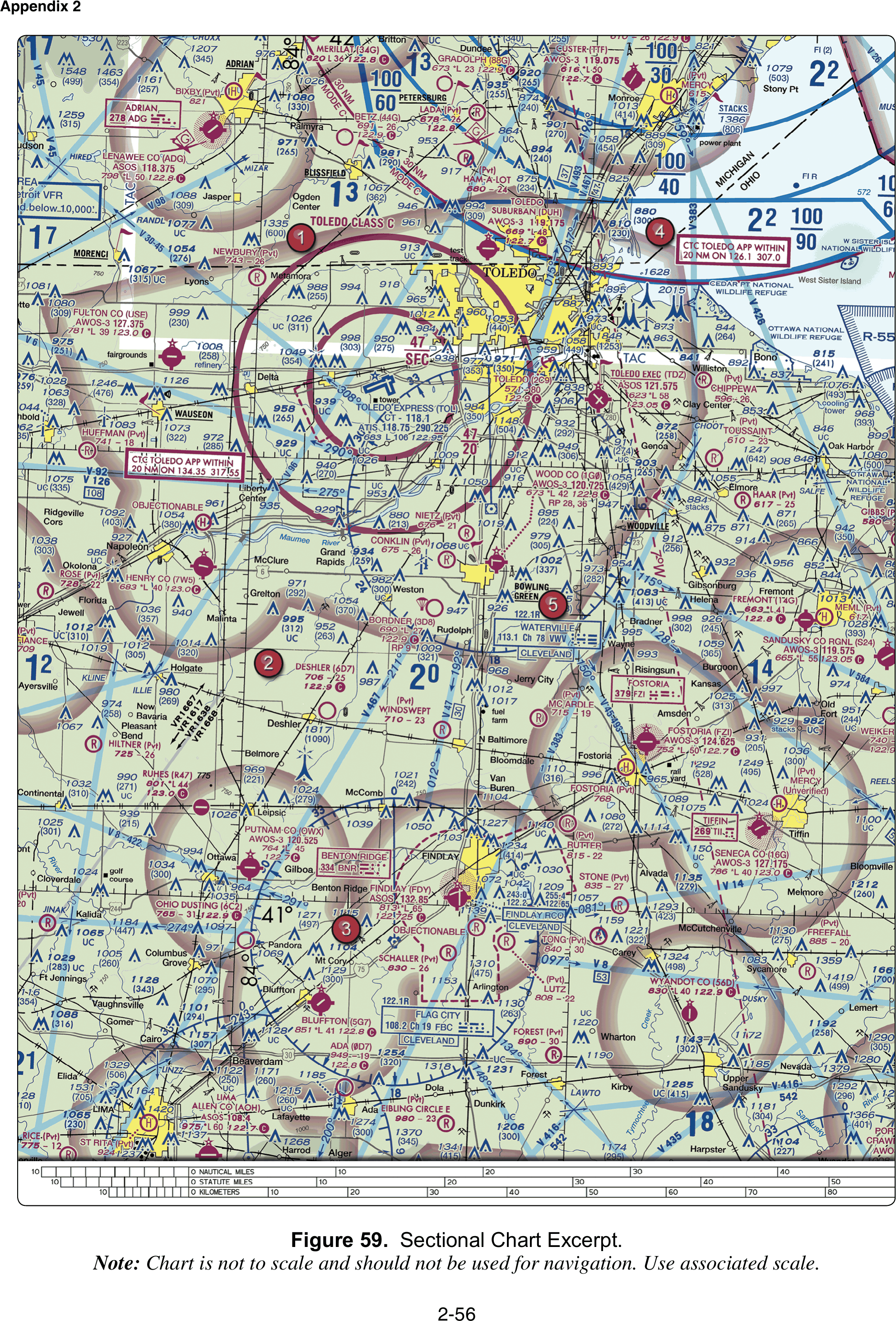
(Refer to FAA-CT-8080-2H, Appendix 2, Figure 59.) The Toledo Class C airspace on this chart is annotated 47/SFC over the airport and 47/20 further out. What are the limits of the outer shelf?
- From the surface up to 4,700 feet MSL
- From 2,000 feet MSL up to 4,700 feet MSL ✓
- From 2,000 feet AGL up to 4,700 feet AGL
Why: Class C ceilings and floors are charted in hundreds of feet MSL, so 47/20 is a ceiling of 4,700 feet MSL over a floor of 2,000 feet MSL. The 47/SFC annotation belongs to the inner circle, which runs from the surface.
What does the remarks section of a METAR begin with, and what may it contain?
- It begins with RMK, and carries only the maintenance status of the station's reporting equipment
- It begins with AO2, and carries the forecast conditions for the following six hours
- It begins with RMK, and may carry wind data, variable visibility and pressure information ✓
Why: The remarks section always begins with the letters RMK. Comments may or may not appear. The information may include wind data, variable visibility, the beginning and ending times of a phenomenon, pressure information and other information deemed necessary.
How is prevailing visibility reported in a METAR?
- In statute miles and fractions of a mile, denoted by the letters SM ✓
- In nautical miles and in tenths of a mile, denoted by the letters NM
- In kilometres and hundreds of metres, denoted by the letters KM
Why: The prevailing visibility is reported in statute miles as denoted by the letters SM, in both miles and fractions of miles. Runway visual range may be reported after it, shown as an R, the runway number, a slant and the visual range in feet.
What service does an operating control tower provide at a towered airport?
- It provides the safe, orderly and expeditious flow of air traffic at that airport ✓
- It issues the remote pilot a written authorisation to fly in the airport's airspace
- It monitors small unmanned aircraft and warns manned traffic of their position
Why: Air traffic control is responsible for providing the safe, orderly and expeditious flow of air traffic at airports where the type of operations or the volume of traffic requires that service. Airspace authorisation for a small UAS is obtained separately, not from the tower by radio.
How is night defined for the purposes of small UAS operations?
- The time between 30 minutes after sunset and 30 minutes before sunrise, in all locations
- The time between the end of evening civil twilight and the beginning of morning civil twilight ✓
- The time between sunset and sunrise as published for the operating location in the Air Almanac
Why: Night is defined in 14 CFR 1.1 as the time between the end of evening civil twilight and the beginning of morning civil twilight, as published in the Air Almanac and converted to local time. In the continental US evening civil twilight runs from sunset until 30 minutes after sunset.
In the report METAR KGGG 161753Z AUTO 14021G26KT, what do the digits 161753Z tell you?
- The observation was taken on the 16th of the month at 1753 coordinated universal time ✓
- The observation was taken at 1617 coordinated universal time on the 53rd day of the year
- The observation covers the period from 1617 to 1753 coordinated universal time that day
Why: Date and time of report is depicted in a six-digit group. The first two digits are the date; the last four are the time, always given in coordinated universal time. A Z is appended to denote Zulu time as opposed to local time.
A remote pilot certificate holder moves house. Within what period must the FAA be notified before privileges lapse?
- 60 days
- 90 days
- 30 days ✓
Why: A certificate holder who changes permanent mailing address may not exercise the privileges of the certificate after 30 days from that date unless the FAA has been notified of the new address. 14 CFR 107.77(c).
What colour are runway edge lights, and what marks the end of the runway?
- White, except amber on the last portion of an instrument runway, with red marking the runway end ✓
- Blue, except green on the last portion of an instrument runway, with white marking the runway end
- Green, except blue on the last portion of an instrument runway, with amber marking the runway end
Why: Runway edge lights are white, except on instrument runways where amber lights are used on the last 2,000 feet or half the runway length, whichever is less. The lights marking the end of the runway are red. Taxiway edge lights are blue. PHAK ch.14.
(Refer to FAA-CT-8080-2H, Appendix 2, Figure 20.) Boxes on this chart read CTC NORFOLK APP WITHIN 20 NM ON 125.7 and CTC NORFOLK APP WITHIN 20 NM ON 118.9 353.7. What are these?
- The common traffic advisory frequencies for the airports inside that radius
- The emergency frequencies reserved for aircraft experiencing a failure in that area
- The approach control frequencies to contact within 20 NM of the associated airspace ✓
Why: A CTC box gives the approach control facility to contact and the frequency to use within the stated distance. Two frequencies are shown for Norfolk Approach because the airspace is divided by sector; 353.7 is the military UHF frequency paired with the civil VHF one.
What is the remote pilot in command's responsibility regarding the condition of the aircraft before flight?
- To ensure the aircraft has been inspected and signed off by an FAA-certificated mechanic within the last 12 calendar months
- To ensure the aircraft has logged fewer flight hours than the manufacturer's stated service life
- To ensure the aircraft is in a safe operating condition and that any irregularity found is corrected first ✓
Why: A remote pilot is responsible for the safe operation of the small UA at all times and must ensure the aircraft is in a safe operating condition before flight. If any irregularities are found in the preflight inspection, they must be corrected before the aircraft is operated.
What does 14 CFR 107.45 require before operating in a prohibited or restricted area?
- Permission from the using or controlling agency, as appropriate to that particular area ✓
- An airspace authorisation obtained from Air Traffic Control through the online portal
- A certificate of waiver issued by the FAA for that specific date and operating site
Why: No person may operate a small unmanned aircraft in prohibited or restricted areas unless that person has permission from the using or controlling agency, as appropriate. 14 CFR 107.45.
To operate a small unmanned aircraft inside a restricted area, the remote pilot needs
- a certificate of waiver issued by the FAA under 14 CFR 107.200
- permission from the using or controlling agency, as appropriate ✓
- an ATC clearance from the facility controlling the overlying airspace
Why: Operation in prohibited or restricted areas requires permission from the using or controlling agency, as appropriate - not an ATC clearance and not a waiver. 14 CFR 107.45.
What are the two main effects of skill fatigue on performance?
- Timing disruption, and disruption of the perceptual field so that the periphery is neglected ✓
- Partial colour blindness, and a loss of depth perception when judging the aircraft's distance
- Hearing loss, and an inability to distinguish one radio transmission from another
Why: Skill fatigue is a special type of acute fatigue with two main effects: timing disruption, where each component of a task is performed slightly off and the operation is less smooth; and disruption of the perceptual field, where attention concentrates on the centre of vision and neglects the periphery.
What is the scale of a sectional aeronautical chart?
- 1:1,000,000, where one inch represents about 13.7 nautical miles or roughly 16 statute miles
- 1:500,000, where one inch represents about 6.86 nautical miles or roughly 8 statute miles ✓
- 1:250,000, where one inch represents about 3.43 nautical miles or roughly 4 statute miles
Why: Sectional charts have a scale of 1:500,000, in which one inch equals 6.86 nautical miles or approximately 8 statute miles. That scale allows detailed airport data, navigational aids, airspace and topography to be shown.
Which operation is NOT governed by 14 CFR part 107?
- A roof inspection flown by an employee of the building's owner
- A real-estate photography flight flown under contract for a client
- A flight flown under part 91 with an airworthiness certificate issued ✓
Why: Part 107 does not apply to air carrier operations, to aircraft operated under 49 U.S.C. 44809, to operations conducted under a section 333 or 44807 exemption, or to any operation a person elects to conduct under part 91 with a small UAS that has been issued an airworthiness certificate. Commercial photography and inspection flights are ordinary part 107 operations. 14 CFR 107.1.